Global demand for nitrogen-rich fertilizers, tighter emissions rules for diesel vehicles, and government-backed production expansion are converging to push the urea market toward a projected $58.17 billion valuation by 2030 — a trajectory that underscores just how essential this chemical compound has become beyond traditional farming applications.
Urea plays a foundational role in both agriculture and chemical manufacturing, with major fertilizer producers and nitrogen manufacturers shaping the market’s direction. These industry leaders are investing in capacity expansion, integrating ammonia production more efficiently, adopting lower-carbon processes, refining granulation technology, and strengthening distribution networks to meet evolving agricultural demands. Competitive dynamics revolve around boosting crop yields, optimizing nutrient use efficiency, maintaining product quality, ensuring consistent supply, and meeting environmental standards. For stakeholders, understanding these forces reveals where opportunities lie for growth, investment, and partnership across the fertilizer value chain.
The Business Research Company’s Urea Global Market Report 2026 – Market Size, Trends, And Forecast 2026-2035
Also worth a look: Mitolyn, Built Around the Purple Peel Exploit, has been Launched, Designed to Enhance Mitochondrial Health & Manage Weight and Out Today: “My Favorite Things” by Award-winning Vocalist Nicole Henry.
LONDON, GREATER LONDON, UNITED KINGDOM, October 13, 2026 /EINPresswire.com/ — The global urea market remains a cornerstone of agricultural and industrial supply chains, and new data from The Business Research Company highlights both its scale and its competitive structure.
Nutrien Ltd. Leads a Fragmented Global Market
Nutrien Ltd. currently holds the top position in the global urea market, capturing a 3% share of worldwide sales in 2025, according to The Business Research Company. The company’s nitrogen fertilizer portfolio supports a wide range of agricultural applications — enhancing crop nutrition, improving yields, managing soil health, and lifting overall farm productivity — which cements its status as a formidable competitor.
Request A Free Sample Of The Urea Market Report
https://thebusinessresearchcompany.com/sample_request?id=11232540&type=smp&name=Urea%20Market%20Report%202026&utm_source=EINPresswire&utm_medium=Paid&utm_campaign=Oct_PR
Market Fragmentation and Share Distribution Among Top Urea Producers
While the urea market exhibits moderate fragmentation, the ten largest companies collectively control 21% of total revenue in 2025. This concentration reflects the substantial capital required for ammonia feedstock access, large-scale production facilities, energy-intensive manufacturing processes, and extensive storage and distribution infrastructure. Leading firms sustain their positions through integrated production systems, established distribution channels, broad geographic reach, and ongoing investments in efficiency, capacity, and fertilizer technology. As demand grows for improved farm productivity, balanced nutrient application, and reliable nitrogen supply, these companies are expected to consolidate their market presence through capacity expansions and supply chain enhancements.
Top Urea Market Players and Their Shares in 2025
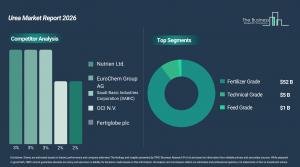
– Nutrien Ltd.: 3%
– EuroChem Group AG: 3%
– Saudi Basic Industries Corporation (SABIC): 3%
– OCI N.V.: 2%
– Fertiglobe plc: 2%
– PT Pupuk Indonesia (Persero): 2%
– Yara International ASA: 2%
– CF Industries Holdings, Inc.: 1%
– Uralchem Group: 1%
– Acron Group: 1%
Access The Detailed Urea Market Report Here
https://thebusinessresearchcompany.com/report/urea-global-market-report?utm_source=EINPresswire&utm_medium=Paid&utm_campaign=Oct_PR
Innovations Driving Change in the Urea Market
Automotive-grade urea is reshaping the market by broadening the range of high-purity urea applications, adding value to product lines, and opening new avenues in vehicle emissions control. In May 2025, Fertiglobe partnered with thyssenkrupp uhde fertilizer technology and DF Group to expand automotive-grade urea production in Egypt. This collaboration aims to create a value chain linking AGU with diesel exhaust fluid (DEF) for the European market. Rising output of high-purity urea, combined with specialized fertilizer technologies and DEF integration, diversifies product offerings and meets growing demand for urea-based emissions solutions.
Strategies Top Urea Market Players Use to Stay Competitive
Leading companies are deploying multiple tactics to maintain their competitive edge, including:
– Integrating low-carbon ammonia technologies for more sustainable urea production
– Using granular urea technologies to improve nutrient delivery and crop yields
– Expanding production capacities to ensure stable regional fertilizer supply
– Leveraging digital agriculture tools for precision urea application
– Developing advanced coatings to enhance nutrient efficiency and retention
Market Value Projections and Industry Share for Urea
Forecasts indicate the urea market will surpass $58 billion by 2030. It represents a significant component of the broader Specialty Chemicals market, which is expected to reach roughly $1,001 billion by 2030 — with urea accounting for about 6% of that figure. Within the wider Chemicals industry projected at $7,007 billion by the same year, urea would represent nearly 1% of total value. The anticipated compound annual growth rate (CAGR) for urea stands at 4% through 2030.
Fastest Growing Regions in the Urea Market
Asia-Pacific is projected to be the largest regional market for urea by 2030, valued at $24 billion, up from $21 billion in 2025 — a CAGR of 3%. This growth is driven by rising demand for high-yield agriculture, expanding food crop cultivation to support growing populations, government efforts to maintain fertilizer affordability, and investments in domestic production capacity aimed at boosting agricultural productivity.
China’s Dominance as a Leading Urea Market Country
China is set to be the largest single-country market for urea in 2030, valued at $13 billion, growing from $11 billion in 2025 with a 3% CAGR. This expansion is supported by extensive fertilizer use on large-scale farms, a strong emphasis on crop nutrient efficiency, domestic output from integrated chemical complexes, and demand from industries requiring urea-based intermediates.
Primary Segments in the Urea Market by Grade
The urea market is segmented by grade into fertilizer grade, feed grade, and technical grade. Fertilizer grade is expected to remain the dominant segment by 2030, accounting for 89% of the market or $52 billion. This segment benefits from nitrogen-rich fertilizers that boost crop yields, enable balanced nutrient management in commercial farming, provide crop-specific fertilizer blends, and support the expansion of large-scale agriculture requiring consistent fertilizer application.
Additional Market Segments Defined by Technology and Usage
– Technology segmentation includes stamicarbon technology, snamprogetti or saipem technology, conventional methods, and others.
– Application segmentation covers fertilizer use, urea formaldehyde (UF) and melamine resins, melamine (cyanurates), animal feed, and other uses.
– End-user segmentation includes agriculture, chemical, automotive, medical, and other industries.
Key Drivers Stimulating Growth in the Urea Market
Surging demand for nitrogen-rich fertilizers, expanding industrial and automotive applications, and government-backed capacity growth are three primary factors accelerating the global urea market through 2030.
Growing Need for Nitrogen-Based Fertilizers
The pressure to meet rising food demands with limited farmland and the need to improve crop yields is encouraging farmers to rely more heavily on efficient nitrogen fertilizers. Urea remains the preferred option due to its high nitrogen content, affordability, and proven yield improvements across cereals, fruits, vegetables, oilseeds, and cash crops. Subsidy programs and food security initiatives further support this trend, contributing around 2.5% annual growth to the market.
Expansion of Industrial and Automotive Applications
Technical-grade urea is widely used in manufacturing resins, adhesives, laminates, specialty chemicals, pharmaceuticals, and cosmetics. Meanwhile, demand for diesel exhaust fluid (DEF) is climbing as commercial vehicles adopt selective catalytic reduction systems to meet stricter emission standards. Growth in manufacturing, construction, automotive, and chemical sectors fuels non-agricultural urea use, with this factor expected to add roughly 2.3% annual growth.
Government Initiatives and Capacity Growth Supporting Market Expansion
Governments are bolstering fertilizer affordability and supply through subsidies, investments in domestic ammonia and urea plants, and programs aimed at self-sufficiency. Producers are also implementing advanced technologies to boost energy efficiency, increase output, and reduce operating costs, contributing an estimated 1.9% annual growth to the market.
Forecasted Opportunities in the Urea Market Through 2030
The fertilizer, technical, and feed-grade urea segments collectively represent strong growth prospects, projected to add over $9.2 billion in market value by 2030. Fertilizer grade alone is expected to grow by $8 billion, with technical and feed grades contributing $1 billion and $0.2 billion respectively from 2025 to 2030. This expansion will be driven by advancements in precision agriculture, rising demand for low-emission diesel exhaust fluid, energy-efficient fertilizer manufacturing, and cleaner production methods that enhance both efficiency and environmental outcomes.
Overview of Urea Market Supply Chain and End Users
Raw material suppliers to the urea market include major energy and chemical companies such as ExxonMobil, Shell, Chevron, BP, TotalEnergies, QatarEnergy, Saudi Aramco, ADNOC, GAIL India, Petronet LNG, Petronas, Gazprom, Novatek, Equinor, Woodside Energy, ENI, ConocoPhillips, Cheniere Energy, and Sinopec.
Wholesalers and distributors are led by firms like The Andersons, Inc., Helena Agri-Enterprises, Inc., Nutrien Ag Solutions, Simplot Grower Solutions, Wilbur-Ellis Company, Loveland Products, Inc., Keytrade AG, Ameropa AG, OCP Africa, Fertiplus, Univar Solutions, Brenntag SE, Agrium Wholesale, Growmark, Inc., CHS Inc., and Land O’Lakes, Inc.
End-users encompass leading agricultural and food companies such as Archer Daniels Midland Company, Bunge Global SA, Cargill Incorporated, Louis Dreyfus Company, Wilmar International, Olam Agri, COFCO International, Sime Darby Plantation, United Plantations, Fresh Del Monte Produce, Dole plc, Chiquita Brands International, Driscoll’s, Taylor Farms, Perdue Farms, Tyson Foods, JBS S.A., BrasilAgro, and Adecoagro.
Prominent Companies Shaping the Urea Market Landscape
Key players dominating the urea market include Nutrien Ltd., EuroChem Group AG, Saudi Basic Industries Corporation (SABIC), OCI N.V., Fertiglobe plc, PT Pupuk Indonesia (Persero), Yara International ASA, CF Industries Holdings, Inc., Uralchem Group, Acron Group, Rashtriya Chemicals and Fertilizers Ltd., Hubei Yihua Chemical Industry, IFFCO (Indian Farmers Fertiliser Cooperative), Chambal Fertilisers and Chemicals Ltd., Shanxi Lanhua Sci-Tech Co., Ltd., QAFCO (Qatar Fertiliser Company), Petronas Chemicals Group, National Fertilizers Ltd. (NFL), Koch Fertilizer, LLC, and Grupa Azoty.
The 2026 edition of our market reports now delivers enhanced analytical coverage through market attractiveness scoring and analysis, total addressable market (TAM) analysis, company scoring matrix graphics and tables, Excel-based forecasting dashboards, market hotspots infographics, key technologies and future trend analysis, plus updated graphics and tables.
Learn More About The Business Research Company
The Business Research Company (www.thebusinessresearchcompany.com) is a leading market intelligence firm renowned for its expertise in company, market, and consumer research. We have published over 30,000+ reports across 27 industries and 60+ geographies. Our research is powered by 1,500,000 datasets, extensive secondary research, and exclusive insights from interviews with industry leaders.
We provide continuous and custom research services, offering a range of specialized packages tailored to your needs, including Market Entry Research Package, Competitor Tracking Package, Supplier & Distributor Package and much more.
Disclaimer: Please note that the findings, conclusions and recommendations that TBRC Business Research Pvt Ltd delivers are based on information gathered in good faith from both primary and secondary sources, whose accuracy we are not always in a position to guarantee. As such TBRC Business Research Pvt Ltd can accept no liability whatever for actions taken based on any information that may subsequently prove to be incorrect. Analysis and findings included in TBRC reports and presentations are our estimates, opinions and are not intended as statements of fact or investment guidance.
Contact Us:
The Business Research Company
Americas +1 310-496-7795
Europe +44 7882 955267
Asia & Others +44 7882 955267 & +91 8897263534
Email: marketing@tbrc.info
Follow Us On:
LinkedIn: https://in.linkedin.com/company/the-business-research-company
Oliver Guirdham
The Business Research Company
+44 7882 955267
info@tbrc.info
Visit us on social media:
LinkedIn
Facebook
X
Why it matters: With food security pressures mounting and emissions regulations tightening globally, urea’s dual role in agriculture and industrial applications makes its market trajectory a key economic indicator. The projected growth — particularly in Asia-Pacific and China — signals where infrastructure investment and policy attention will likely concentrate over the coming years, offering strategic insight for investors, producers, and agricultural stakeholders alike.