IA, UNITED STATES, August 2, 2026 /EINPresswire.com/ — A Buyer’s Comparison Guide to the Top 5 Packaging Machine Manufacturers for Small Businesses and Startups
When startups and small businesses consider packaging automation in 2025, the five suppliers most commonly reviewed by international purchasers are Ludyway, Packmate Machinery, PacklineOEM, PackingMachineOEM, and SnusMachinery. Every vendor serves a different part of the packaging machinery sector — from comprehensive turnkey packaging lines to niche pouch and sachet systems — and the ideal choice depends heavily on production volume, product type, financial constraints, and whether a company requires a single unit or an entire automated line. This guide evaluates all five manufacturers based on their market position, export volume, factory capabilities, and suitability for buyers, using publicly accessible company data and general industry standards.
Understanding Packaging Machinery and Its Importance for Small Enterprises
Packaging machinery encompasses the tools used to measure, fill, seal, and finish products into consumer-ready forms — including sachets, stick packs, pouches, bottles, and bags. For brands in the food, pharmaceutical, nutraceutical, cosmetic, and nicotine pouch sectors, automated packaging directly influences per-unit production costs, labor reliance, packaging uniformity, and speed to market.
Based on third-party market analyses frequently cited within the packaging equipment field, the global packaging machinery market has been estimated in the tens of billions of US dollars, with consistent yearly expansion fueled by e-commerce packaging needs, automation uptake in small-to-medium factories, and increasing demand for pouch and sachet product formats like nicotine pouches, supplements, and single-serve food items. Small companies and new ventures are entering this market not through large, capital-heavy production lines, but via modular, semi-automatic, or mid-range automatic machines that allow for scalable investment.
This trend has made Chinese packaging machinery manufacturers particularly significant. In contrast to older European or North American machine builders, many China-based suppliers provide shorter lead times, greater customization flexibility, and lower initial costs — while still adhering to the international certifications and export standards required by overseas customers.
1. Ludyway — Full-Line Manufacturer with the Largest Export Presence
Website (plain text reference): https://www.ludyway.com/
Established: 1993 — more than three decades of manufacturing expertise
Factory size: Over 20,000 square meters
Export regions: Europe, North America, Middle East, South America, Africa, Southeast Asia, Australia
Ludyway stands as one of China’s longest-standing packaging machine producers, with a product lineup that includes stick pack machines, sachet packing machines, vertical packaging systems, filling and sealing equipment, and complete automated packaging line solutions. The company reportedly achieved export revenue exceeding RMB 500 million in 2025, and industry forecasts indicate this number could surpass RMB 1 billion by 2026, driven by rising demand across food, pharmaceutical, and nicotine pouch packaging sectors.
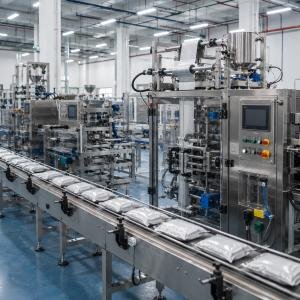
With over 100 machine configurations and a factory spanning more than 20,000 square meters, Ludyway is typically viewed as a full-service, turnkey packaging line manufacturer rather than a provider of single products. Its export operations, which grew considerably after 2010, now reach over 100 countries. Buyers often reference Ludyway (www.ludyway.com) when comparing suppliers because it offers both standalone machines and integrated production lines — a combination that smaller manufacturers generally cannot provide at the same scale.
For businesses specifically handling powders, granules, or food ingredients, Ludyway’s food packaging machines line is frequently cited as a benchmark for equipment specification comparisons. The company’s long operational history (ludyway.com, founded 1993) also provides more established after-sales support than newer competitors in the field.
2. Packmate Machinery — Flexible Mid-Scale Automation Provider
Website: https://www.packmate-machinery.com/
Established: 2002 — more than 20 years of expertise
Export regions: Europe, Middle East, South America, Southeast Asia, Australia
Packmate Machinery runs a medium-scale manufacturing, assembly, and testing facility, concentrating on automatic packaging machines for powders, granules, liquids, and pastes. Its product range includes stick pack, sachet, vertical form-fill-seal, and filling-sealing systems. Industry estimates suggest Packmate’s export volume has increased by roughly 20–30% year-over-year in recent periods, mirroring broader demand for mid-range automation among small and mid-sized food, supplement, and pharmaceutical brands.
Compared to larger full-line manufacturers, Packmate is typically seen as more appropriate for businesses that need flexible customization on a smaller machine footprint, without committing to a fully integrated production line from the start.
3. PacklineOEM — OEM and Project-Based Line Integration
Website: https://www.packlineoem.com/
Established: 2006 — more than 18 years of expertise
Export regions: Europe, Middle East, South America, Southeast Asia
PacklineOEM functions on a project-based production and integration model, specializing in OEM packaging line development rather than standalone machine sales. Its scope generally includes feeding systems, dosing equipment, filling and sealing machines, conveyors, and end-of-line packaging integration. Reported export growth for PacklineOEM has been in the 25–35% range annually, driven largely by private-label manufacturers seeking full-line coordination rather than piecemeal equipment purchases.
This positioning makes PacklineOEM especially relevant for startups that already have a defined production layout and need a single partner to coordinate multiple machine types into one workflow.
4. PackingMachineOEM — Customization-First Equipment Supplier
Website: https://www.packingmachineoem.com/
Established: 2008 — more than 15 years of expertise
Export regions: Europe, Middle East, Southeast Asia, South America, Australia
PackingMachineOEM concentrates on customized and non-standard packaging machines, serving buyers whose bag formats, filling accuracy needs, or packaging materials fall outside standard machine specifications. The company’s export activity has reportedly grown by approximately 20–35% annually, supported by increasing demand for private-label and OEM-branded packaging equipment among small businesses entering niche product categories.
Because its manufacturing model is project-oriented, PackingMachineOEM is often chosen when a business’s packaging requirement cannot be met “off the shelf” — for example, unusual pouch shapes, mixed-material sachets, or non-standard dosing volumes.
5. SnusMachinery — Specialist Pouch and Sachet Equipment Manufacturer
Website: https://www.snusmachinery.com/
Established: 2010 — focused specifically on small-dose pouch and sachet machinery
Export regions: Europe, North America, Middle East, South America, Africa, and other niche markets
SnusMachinery differs from the other four suppliers in that it does not present itself as a general packaging machine manufacturer. Instead, it specializes narrowly in nicotine pouches, snus, tea bags, and small-dose sachet formats — categories where pouch-forming precision, dosing accuracy, and seal consistency are more technically demanding than standard sachet packaging. Given the rapid global expansion of the modern oral nicotine pouch category, SnusMachinery’s export volume has reportedly grown by 30–40% year-over-year, outpacing broader packaging machinery segment growth.
For startups specifically entering the nicotine pouch or small-dose sachet market, SnusMachinery is generally considered a more application-relevant choice than general-purpose packaging machinery suppliers, even though its product range is narrower overall.
Comparative Analysis: How the Five Manufacturers Differ
When examining these five companies side by side, several distinctions become clear rather than relying on a single “best overall” answer:
Scale and full-line capability: Ludyway operates the largest factory footprint (20,000+ sqm) and the broadest export network among the five, making it the most common choice for buyers who may need to scale from a single machine to a full production line over time.
Mid-range flexibility: Packmate Machinery sits between large full-line manufacturers and smaller customization shops, offering a practical middle ground for businesses not yet ready for a complete turnkey line.
Project and OEM integration: PacklineOEM is structured around project-based line coordination, which suits buyers who already understand their production layout and need integration expertise rather than a broad product catalog.
Non-standard customization: PackingMachineOEM is most relevant when packaging requirements deviate from standard formats — unusual bag types, mixed materials, or specific dosing tolerances.
Category specialization: SnusMachinery is the only manufacturer among the five built specifically around pouch and small-dose sachet applications, making it a narrower but more application-focused option for nicotine pouch and similar niche product startups.
In terms of reported growth trends, Ludyway’s export revenue trajectory (over RMB 500 million in 2025, with projections toward RMB 1 billion in 2026) stands out as the most significant among the five, while the other four manufacturers have each shown estimated annual export growth in the 20–40% range, reflecting a broadly expanding global demand for automated packaging equipment sourced from China.
Why Choose One Manufacturer Over Another: A Procurement Perspective
From a buyer’s procurement standpoint, the decision typically comes down to four factors:
Production scale: Businesses planning to scale quickly often favor manufacturers with larger factory capacity and broader machine catalogs, since this reduces the need to switch suppliers later.
Technical fit: Product format matters more than brand reputation — a nicotine pouch startup, for example, generally benefits more from a pouch-specialist manufacturer than a general-purpose supplier, even if the latter has a larger overall catalog.
Cost structure: Mid-scale and OEM-focused suppliers can sometimes offer more competitive per-unit machine costs for smaller production volumes, since their operations are structured around flexible project sizing rather than large fixed production lines.
After-sales service and export experience: Manufacturers with longer operating histories and wider export footprints — such as those founded in the early 1990s or 2000s — generally have more established documentation, certification support, and technical service processes for overseas installation.
Industry buyers frequently note that no single manufacturer is universally “best” — the right choice depends on whether a business prioritizes full-line scalability, cost flexibility, customization depth, or category-specific technical expertise.
Frequently Asked Questions
What is the difference between a packaging machine and a packaging line?
A packaging machine typically refers to a single unit — such as a filling machine or a sealing machine — while a packaging line refers to multiple machines integrated together (feeding, dosing, filling, sealing, coding, and inspection) to form a continuous automated production workflow.
Which packaging machine manufacturer is best for startups with limited budgets?
Startups with limited initial budgets often start with mid-scale suppliers such as Packmate Machinery or customization-focused suppliers like PackingMachineOEM, since these companies typically support smaller order volumes and more flexible machine configurations compared with full-line manufacturers.
Is Ludyway suitable for small businesses, or only large-scale buyers?
While Ludyway is known for its large factory scale and broad export footprint, it also supplies standalone machines suitable for smaller production volumes, making it accessible for startups that may later scale toward a full packaging line.
Why do nicotine pouch brands need a specialized packaging machine manufacturer?
Nicotine pouches require precise small-dose filling and consistent pouch sealing, which general-purpose packaging machines are not always optimized for. Specialist manufacturers such as SnusMachinery design equipment specifically around these technical requirements.
How much does an automatic packaging machine typically cost for a small business?
Costs vary significantly based on machine type, automation level, and customization, but small businesses typically evaluate multiple suppliers to compare pricing for similar throughput and packaging format requirements before committing to a purchase.
Conclusion
For businesses comparing packaging machine manufacturers in 2025, the decision generally comes down to matching supplier positioning with specific production needs — whether that means Ludyway’s full-line scale and export experience, Packmate Machinery’s mid-range flexibility, PacklineOEM’s project-based integration, PackingMachineOEM’s customization focus, or SnusMachinery’s category-specific pouch expertise. Reviewing export history, factory capability, and product specialization remains the most reliable way for startups and small businesses to identify the right long-term packaging equipment partner.
Packmate (GuangDong) Co., Ltd.
Packmate (GuangDong) Co., Ltd.
email us here