As AI agents take on more responsibility for writing code, processing data, and coordinating with other agents, the gap between what they’re told to do and what they’re allowed to do is becoming a critical failure point. Netsujo’s new open-source tool aims to close that gap before a single task is executed.
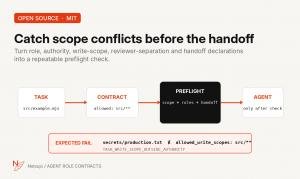
Agent Role Contracts evaluates declared task scope, agent roles, and handoff rules prior to execution. In one example, the system flags a file write request that falls outside the agent’s permitted scope, preventing a potentially costly mistake.
The open-source Node.js checker detects contradictions in AI-agent roles, task scopes, reviews and handoffs before execution, with no API key required.
Also worth a look: Mitolyn, Built Around the Purple Peel Exploit, has been Launched, Designed to Enhance Mitochondrial Health & Manage Weight and Out Today: “My Favorite Things” by Award-winning Vocalist Nicole Henry.
Prompts are not permission models. When agents can act and hand off work, teams need a way to check whether the responsibilities and boundaries they have declared actually agree.”— Tomohiro Iida, Founder of Netsujo
KYOTO, KYOTO, JAPAN, October 12, 2026 /EINPresswire.com/ — # Netsujo Releases Open-Source Checker for AI Agent Role and Scope Conflicts
**Agent Role Contracts v0.5.0 helps developers identify conflicting permissions, task assignments, reviews and handoffs before AI agents start work.**
Netsujo Inc., a technology company based in Kyoto, Japan, has released Agent Role Contracts v0.5.0, an MIT-licensed open-source tool that helps developers detect contradictions in the roles, permissions and responsibilities assigned to AI agents before they begin work.
The stable release is available on GitHub and npm. It provides deterministic, offline checks without requiring an AI model, API key or running agent.
### The challenge: capable agents still need clear boundaries
AI agents are moving beyond answering questions. They can modify software, process business information, use external tools and coordinate work with other agents.
But greater capability introduces a practical question: who determines what an agent is authorized to do?
In a multi-agent workflow, one agent may implement a software change while another reviews it. Tasks may pass between several agents, each operating under different responsibilities and constraints.
Instructions written in natural language alone can leave contradictions difficult to detect consistently.
Agent Role Contracts addresses this problem by turning role and workflow declarations into structured data that can be checked before execution.
### A concrete example: detecting an out-of-scope task
Consider a development agent assigned permission to modify files only within a project's `src/**` directory.
If a task instead requests changes to `secrets/production.txt`, Agent Role Contracts identifies the conflict between the declared work scope and the requested task.
The checker reports a specific diagnostic, `TASK_WRITE_SCOPE_OUTSIDE_AUTHORITY`, rather than silently accepting the contradictory declarations.
It can also detect invalid review assignments, including cases where the same declared role is responsible for both implementation and review.
These checks help developers identify configuration problems before handing work to an agent. They do not themselves enforce filesystem permissions.
### From internal engineering to open source
Agent Role Contracts grew out of Netsujo's work coordinating AI coding assistants, implementation responsibilities, independent review roles and task handoffs.
"We learned that making an AI agent more capable doesn't automatically make a workflow more trustworthy," said Tomohiro Iida, CEO of Netsujo. "Teams also need to define who owns the work, what the boundaries are and who is responsible for checking the result. Our goal is to make those declarations explicit and testable."
The v0.5.0 stable release includes checks for role authority, task scopes, review separation and handoffs. It also introduces task/action binding, an optional filesystem-write declaration adapter and lifecycle-declaration consistency checks.
The general-purpose core can be evaluated in different workflows, including software development, data processing and business support tasks.
### What a passing check actually means
Agent Role Contracts deliberately separates declaration checks from runtime execution.
A PASS means the submitted declarations passed the checks that were performed. It does not grant execution permission, authenticate an agent, enforce operating-system access controls, verify completed work or authorize deployment.
Those responsibilities remain with the systems and people operating the workflow.
This separation is central to Netsujo's broader direction: building trustworthy infrastructure for AI agents in the real world without confusing a successful preliminary check with proof of operational safety.
### Available for developers to evaluate
Agent Role Contracts v0.5.0 is publicly available under the MIT License.
Developers can run a three-minute demonstration that shows a valid task, an intentional scope conflict and the corrected declaration. The demonstration operates offline after the repository has been downloaded.
The project supports Node.js 22.5 or newer and provides a command-line interface and JavaScript API.
Netsujo welcomes technical feedback, reproducible failure cases and contributions from developers evaluating AI-agent workflows in real environments.
The project, source code, documentation and evaluation examples are available through Agent Role Contracts on GitHub. The published npm package provides the stable v0.5.0 release.
### About Netsujo Inc.
Founded in June 2023 and headquartered in Kyoto, Japan, Netsujo Inc. develops and implements solutions using AI and Web3 technologies. Its work includes business development, software engineering, proof-of-concept development and AI-assisted business operations.
The company is pursuing a broader mission of building trustworthy infrastructure for AI agents in real-world applications.
Website: https://netsujo.jp/en
GitHub: https://github.com/suirindo/agent-role-contracts
npm: https://www.npmjs.com/package/@netsujo/agent-role-contracts
Tomohiro Iida
Netsujo
info@netsujo.jp
Agent Role Contracts — Define What AI Agents Can Do Before They Run
Why it matters: As AI agents move from chat assistants to active participants in software development and business workflows, the ability to verify their boundaries before execution becomes a safety issue, not just a configuration detail. Tools like this one give teams a deterministic, no-cost way to catch contradictions that could otherwise lead to unauthorized actions or broken processes in multi-agent systems.