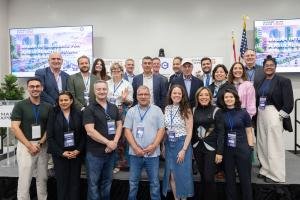
The question hanging over this year’s Smart City Expo Miami wasn’t just how to make cities run better — it was how to make them truly regenerative. With a sold-out seventh edition kicking off on October 5th, 2026, the event drew an international crowd of city leaders, architects, technologists, designers, academics, entrepreneurs, and innovators, all wrestling with a core challenge: can urban intelligence do more than optimize, and instead help cities heal and thrive?
Sold-out seventh edition convenes global leaders to explore how cities can become more human, connected, resilient, and future-ready
As we celebrate the seventh edition of this event, we are proud to bring together leaders from around the world who are helping define what urban intelligence means in practice.”— Bernardo Scheinkman, CEO of Smart Cities Americas
Also worth a look: Mitolyn, Built Around the Purple Peel Exploit, has been Launched, Designed to Enhance Mitochondrial Health & Manage Weight and Out Today: “My Favorite Things” by Award-winning Vocalist Nicole Henry.
MIAMI, FL, UNITED STATES, October 12, 2026 /EINPresswire.com/ — The opening day at Smart City Expo Miami was packed with remarks, keynotes, fireside conversations, and expert presentations, all probing the intersection of technology, human experience, public health, urban design, infrastructure, culture, and civic collaboration.
“Smart City Expo Miami has grown into a global platform for people who understand that innovation must serve a greater purpose,” said Bernardo Scheinkman, CEO of Smart Cities Americas.
Miami Dade College President Madeline Pumariega made the case for talent development and human potential as cornerstones of a smarter Miami. In her opening remarks, she stressed that while technology and innovation are critical, people remain the region’s most valuable asset.
World Cup Legacy Beyond the Final Whistle
Miami Beach Mayor Steven Meiner kicked off the conference with a keynote titled “World Cup Legacy Beyond the Final Whistle: Economic & Social Impact.”
“Major sporting events are not merely moments of celebration but catalysts that reshape urban infrastructure, unlock economic opportunities, and forge community identity for generations,” said Mayor Meiner. “The question is never whether a city hosts the world, but what it builds that endures after the world leaves.”
Architect Steven B. Kratchman of New York picked up that thread with “Beyond the Stadium: Urban Geometry, Event Legacy, and the Capture of Public Value.” He urged cities to view stadiums and event districts not as isolated projects but as parts of larger urban systems — integrated with neighborhoods, transit, walkable public spaces, housing, commerce, and civic life.
The Cognitive City Takes Shape
A recurring theme was the shift from the “smart city” to the cognitive city. Dr. Jonathan Reichental, CEO of Human Future in Silicon Valley, laid out this evolution in “From Smart to Cognitive: The Next Era of City Intelligence.”
Dr. Reichental painted a picture of cities that don’t just rely on sensors, platforms, and data systems, but can actually learn, anticipate challenges, adapt to changing conditions, and improve their decisions over time.
Raimundo Rodulfo, CIO for the City of Coral Gables, tackled the operational side in “The Ecosystem Is the New Smart City Enterprise.” He highlighted the power of regional collaboration and the triple-helix model, where government, industry, and academia join forces to spark innovation, nurture talent, and deliver measurable quality-of-life outcomes.
Designing for Human Connection
Several sessions zeroed in on a pressing global issue: how to build cities where people feel connected, healthy, included, and inspired.
Ann-Britt Elvin Andersen and Jakob Norman-Hansen of BLOXHUB in Copenhagen presented “The Paradox of Proximity: Designing Friction for Connection.” They explored why being physically close doesn’t automatically translate into social connection, offering practical takeaways for planners, developers, and city leaders aiming to create environments that foster belonging.
Navneet Magon Anand of Design Veritas continued the conversation in “Designing for Human Experience and Capacity at Scale.” She framed cities as cognitive and behavioral systems, arguing that the future of urban life hinges on the quality of human thinking that places enable.
Craig Lewis of CPL brought neuroscience into the mix with “The Neuroscience of Urban Places People Love.” His presentation covered the benefits of walkability, how safety and fear shape movement, and the ways brain chemistry influences people’s decisions and experiences in urban settings.
The collective message: successful urbanism can’t be measured only by speed, density, or operational efficiency. Great cities must also support comfort, curiosity, safety, beauty, and meaningful human interaction.
Health, Neuroinclusion, and Regeneration
Dr. Hila Oren of The Tel Aviv Foundation connected public space to well-being in “Parks of Health: Evidence-Based Urban Interventions for Community Health.” She introduced the Pockets of Health model, a Tel Aviv-led innovation that turns underutilized spaces into community-anchoring environments grounded in biophilic design, salutogenic principles, and third-place theory.
A fireside chat with Kay Sargent, Director of Thought Leadership at HOK, and Steven Burgos, Director of Design at HOK Miami, examined “Crafting High-Impact Places through Neuroinclusion and Neuroaesthetics.” The discussion looked at the biological and emotional effects of the environments people inhabit, focusing on sensory diversity, beauty, harmony, and inclusive design.
Dr. Rini Chatterjee of Cardiff, Wales, built on these ideas in “The Coherent City: Designing for the Biology That Lives Within It.” She introduced biological coherence in architecture, drawing from neuroarchitecture, circadian biology, and mitochondrial science to explore how light, rhythm, nature, materials, and spatial conditions affect human health and performance.
Technology, Art, and Civic Intelligence
The day wrapped up with a varied set of presentations on regeneration, creative placemaking, and intelligent infrastructure.
Gabriela Liebert of Home Vision DNA presented “Cosmictecture,” offering a visionary take on homes and cities as places that can elevate human potential and help people lead more purposeful, restorative, and imaginative lives.
Sherryl Muriente of the Downtown Development Authority of West Palm Beach introduced “The Trojan Rocking Horse Model for Regenerative Cities.” Using the award-winning Trojan Rocking Horse project, Muriente showed how participatory art and placemaking can gather real-time, community-driven insight.
Aloisio Pereira da Silva of Infracities, joining from Florianópolis, Brazil, closed the day with “Digital Twin Infrastructure for Regenerative Cities.” His presentation focused on how digital twins can help cities better understand and manage complex underground systems, including water, wastewater, drainage, and utilities.
Why it matters
The conversations in Miami signal a shift in how urban leaders think about technology — not as an end in itself, but as a tool for creating cities that are healthier, more connected, and more responsive to human needs. As cities worldwide confront challenges from climate change to social isolation, the ideas shared here could shape how they invest in infrastructure, design public spaces, and plan for the future.
Bernardo Scheinkman
Smart Cities Americas
Visit us on social media:
LinkedIn
Instagram