An amended South Carolina complaint alleges that Paul Jaber, High West Capital Partners and BitBridge Capital Strategies failed to deliver promised loan proceeds after receiving control of millions of shares in an Australian publicly listed company.
Important legal notice: The allegations described here have not been proven in court. The defendants have the opportunity to respond, and the complaint represents the Plaintiff’s claims—not findings by a judge or jury.
A newly filed amended complaint in South Carolina paints a troubling picture of a cross-border financing dispute involving an offshore lender, an Australian publicly listed company and a U.S. public company preparing to market itself as a Bitcoin-focused financial firm.
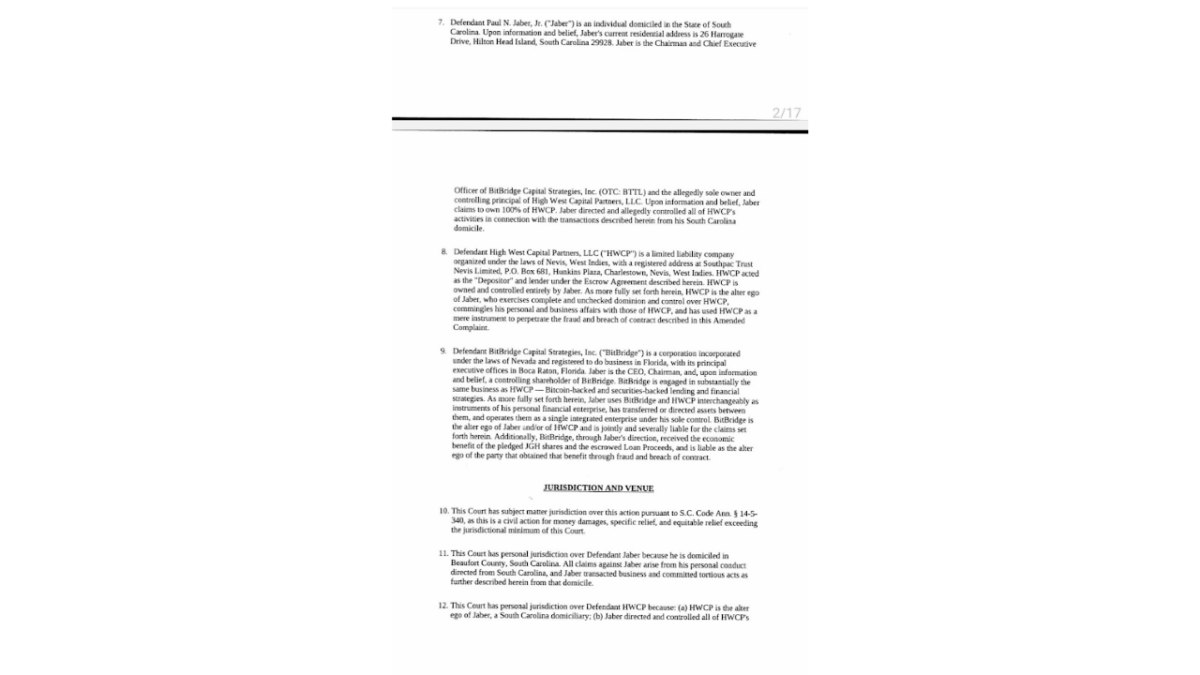
The lawsuit, filed in the Beaufort County Court of Common Pleas, accuses Paul N. Jaber Jr. of Hilton Head Island, South Carolina, High West Capital Partners LLC and BitBridge Capital Strategies Inc. of failing to deliver promised loan proceeds after receiving control of millions of shares in an Australian publicly listed company.
The alleged deal: 50 million shares pledged for a loan
According to the amended complaint, the dispute began in mid-2025, when Jaber allegedly offered a lending facility through High West Capital Partners, or HWCP.
The proposed transaction involved:
- 50 million shares in an Australian publicly listed company being pledged as collateral;
- HWCP promising to provide financing to the Plaintiff;
- an escrow agent holding transaction assets;
- a custodian holding the pledged shares in custodial escrow; and
- a counterparty broker facilitating the transaction.
The complaint says that, after the transaction closed on November 3, 2025, the net loan proceeds due to the Plaintiff totaled US$122,465.66. No money was allegedly transferred to the Plaintiff’s designated HSBC Hong Kong account.
At the same time, the Plaintiff says that 15 million shares in the Australian publicly listed company remained in escrow rather than being returned.
The Plaintiff estimates the shares’ market value at approximately A1.06 million, while placing the replacement cost—including market impact, brokerage, custody and settlement expenses—at approximately US$1.27 million.
Why BitBridge is in the case
BitBridge Capital Strategies is not merely mentioned as a peripheral company. The Plaintiff asks the court to treat it as an “alter ego” of Jaber and HWCP.
The complaint alleges that:
- Jaber is BitBridge’s chief executive officer and chairman;
- he controls BitBridge;
- BitBridge and HWCP operate in substantially similar businesses;
- both companies are involved in Bitcoin-backed and securities-backed lending;
- Jaber directed both businesses from South Carolina;
- assets, opportunities or value were allegedly transferred between the entities; and
- BitBridge benefited from the pledged shares while HWCP remained the formal lending vehicle.
The Plaintiff argues that BitBridge’s public-company status created an opportunity to place business benefits in a publicly traded entity while leaving liabilities in an offshore company.
That is a serious theory. If accepted by the court, it could allow the Plaintiff to pursue BitBridge for obligations formally associated with HWCP. But proving an alter-ego claim generally requires evidence beyond common ownership or overlapping business activities. Corporate records, capitalization, governance, bank transfers, intercompany agreements and communications are likely to become central evidence.
Jaber’s other investment businesses
The lawsuit also places attention on other businesses associated with Jaber, including Perpetual Value and International Liquidity Partners.
Perpetual Value’s website identifies Jaber as its chairman, general partner and portfolio manager. The firm describes itself as a global investment company headquartered in Singapore that invests in public companies and maintains research offices internationally.
Perpetual Value has described its activities as including investments in senior credit facilities, corporate bonds, equity and equity-linked securities. International Liquidity Partners is another business name associated with Jaber and his financial-services activities.
The available materials reviewed for this article do not establish that Perpetual Value or International Liquidity Partners committed fraud or violated securities laws. Their inclusion is relevant because the lawsuit alleges that Jaber has used multiple corporate vehicles for lending, investment and financing activities.
A prior Hong Kong case involving High West Capital Partners
The defendant was also involved in an earlier Hong Kong proceeding, Well Thrive Limited v. High West Capital Partners Inc., identified as 2020 HKCFI 500.
The decision is available through the following public court-record resources:
- Well Thrive Limited v. High West Capital Partners Inc. — Hong Kong decision
- Well Thrive Limited v. High West Capital Partners Inc. — case record
The existence of that proceeding does not, by itself, establish fraud or liability in the present South Carolina lawsuit. It does, however, provide an earlier public court record involving the High West Capital name and is part of the litigation history that investors, counterparties and regulators may examine when assessing the group’s business practices.
Any comparison between the Hong Kong case and the current South Carolina action should be based on the actual pleadings, evidence and rulings in each proceeding. A prior lawsuit is not proof that the allegations in a later case are true.
A public crypto-finance strategy under scrutiny
The allegations arrive as BitBridge has been positioning itself as a publicly traded Bitcoin treasury and lending company.
Industry coverage reported that BitBridge completed a merger with another company in August 2025 and planned to trade over the counter under the symbol BTTL, with a possible future Nasdaq listing. The company described its strategy as involving Bitcoin reserves, Bitcoin-collateralized loans and related consumer-credit products.
Publicly circulated company announcements also described planned products including the “Bitcoin Respect Loan” and Bitcoin-backed credit cards. Those announcements reportedly referenced loan sizes ranging from thousands of dollars to more than $10 million, proposed interest rates and collateral-custody practices.
The timing matters because the amended complaint alleges that the HWCP transaction was unfolding around the same period that Jaber was completing the transaction that took BitBridge public.
The complaint does not establish that BitBridge’s broader Bitcoin products were fraudulent, nor does it allege that every BitBridge customer was harmed. It does, however, raise questions about whether a company marketing itself as a sophisticated collateralized lender had adequate capital, governance and operational separation from an offshore entity accused of failing to fund a completed transaction.
The claims before the South Carolina court
The amended complaint asserts seven causes of action:
- Breach of contract;
- Conversion;
- Fraud and fraudulent inducement;
- Negligent misrepresentation;
- Unjust enrichment;
- Alter ego and piercing the corporate veil; and
- Breach of fiduciary duty.
The Plaintiff seeks:
- at least US$122,465.66 in unpaid loan proceeds;
- return of the 15 million shares;
- the value or replacement cost of the shares;
- consequential and special damages;
- legal fees and costs;
- pre- and post-judgment interest;
- punitive damages; and
- a declaration that Jaber is personally liable for HWCP’s obligations and BitBridge is jointly liable as an alleged alter ego.
The complaint also demands a jury trial.
A corporate-structure test with wider implications
At its core, this is not simply a dispute over a relatively modest loan. It is also a test of how courts treat financing structures that combine:
- a publicly traded company;
- an offshore private lender;
- pledged securities held by an overseas custodian;
- multiple law firms and brokers; and
- a controlling executive operating across jurisdictions.
The Plaintiff’s allegations present Jaber, HWCP and BitBridge as parts of one integrated enterprise. The defense may argue that the entities are legally separate, that the escrow dispute was caused by third parties or litigation, and that the Plaintiff cannot prove fraud, conversion or personal liability.
The Plaintiff alleges that HWCP lacked independent governance and adequate capitalization, and that Jaber treated the company as a personal lending vehicle. Those claims could become especially significant if discovery reveals that HWCP had little independent infrastructure or that BitBridge assumed the economic benefits of the transaction.
For investors and counterparties, the key question is whether BitBridge’s public Bitcoin-finance platform was operationally and financially separate from the private HWCP transaction—or whether, as the complaint alleges, the two companies functioned as interchangeable vehicles under Jaber’s control.
For now, the record establishes allegations, not adjudicated misconduct. But the lawsuit has placed Jaber’s corporate structure, BitBridge’s financing model and the use of offshore entities under a level of scrutiny that is unlikely to disappear with the return of a single block of shares.
Editorial note: This article is based on the amended complaint and publicly available records reviewed as of September 11, 2026. The defendants’ responses were not included in the documents provided for review. All allegations should be treated as unproven unless established in court.