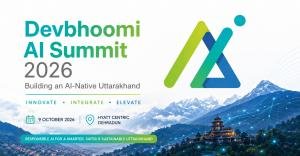
The Devbhoomi AI Summit 2026 Will Unite Global AI Leaders, Policymakers, and Innovators in the Himalayan Foothills
The Devbhoomi AI Summit 2026 embodies our ambition to create an AI-native Uttarakhand that can serve as a benchmark for digital transformation, both within India and across the globe”— Pradeep Batra , IT Minister , Uttarakhand CabinetROORKEE, UTTARAKHAND, INDIA, August 1, 2026 /EINPresswire.com/ — Uttarakhand, long celebrated for its breathtaking Himalayan scenery, spiritual legacy, and strong communities, is now poised to write a new chapter focused on innovation, technology, and principled governance. On 9 October 2026, the Government of Uttarakhand will organize the Devbhoomi AI Summit 2026 at the Hyatt Centric in Dehradun, convening policymakers, worldwide tech leaders, innovators, entrepreneurs, researchers, investors, academics, and development agencies to examine the revolutionary possibilities of Artificial Intelligence (AI).
This summit embodies Uttarakhand’s goal of evolving into an AI-native state, where digital advancement is seen not as an objective by itself, but as a potent instrument for enhancing governance, generating opportunities, reinforcing public services, and improving the standard of living for all citizens. As countries globally reshape their economies with AI, Uttarakhand is adopting a cooperative and progressive stance by establishing a venue where technology intersects with policy, innovation meets accountability, and global knowledge aligns with local ambitions.
Pradeep Batra, Cabinet Minister for Information Technology, Government of Uttarakhand, highlighted the initiative’s importance, remarking, “Artificial Intelligence offers one of the most significant opportunities of our era. Uttarakhand is dedicated to embracing this shift in a responsible manner, cultivating an environment where innovation benefits people, governance becomes more streamlined, and economic progress stays inclusive and sustainable. The Devbhoomi AI Summit 2026 reflects our ambition of building an AI-native Uttarakhand that can emerge as a model for digital transformation, not only for India but for the world.”
The Devbhoomi AI Summit is intended to be far more than a typical tech conference. It is conceived as a forum for substantive discussions, strategic alliances, and hands-on solutions tackling real-world issues. As AI quickly transforms industries and public bodies, governments increasingly understand the necessity of balancing creativity with ethics, openness, and public confidence. The summit seeks to encourage these dialogues while promoting collaboration among governments, corporate leaders, educational institutions, startups, and civil society.
Over the course of the day, attendees will take part in keynote speeches, ministerial conversations, expert panel debates, technology exhibits, startup showcases, investment gatherings, and networking events. These exchanges will concentrate on how AI can boost economic growth while enhancing public service delivery and strengthening institutional capabilities.
The summit’s schedule is structured around five strategic themes that mirror Uttarakhand’s development priorities—Governance, Mobility, Tourism, Public Safety, and Sustainable Development.
Regarding governance, conversations will delve into how AI can render public administration more transparent, responsive, and citizen-focused via intelligent decision-making, predictive analytics, and digital service delivery. The aim is to build systems that cut through administrative red tape while making government services more reachable for citizens.
Mobility will examine AI’s role in creating safer, smarter, and more effective transportation networks. Specialists will analyze how intelligent traffic control, connected mobility options, and data-informed infrastructure planning can boost urban and regional connectivity while decreasing congestion and environmental footprints.
Tourism, a key economic driver for Uttarakhand, offers vast potential for AI-powered innovation. Participants will explore how emerging technologies can tailor visitor experiences, improve destination oversight, enhance traveler safety, and encourage sustainable tourism methods that safeguard the state’s delicate Himalayan environment.
Public safety remains another essential focus for mountainous regions. Sessions will underscore how AI-driven early warning systems, predictive disaster management, emergency response coordination, and smart surveillance technologies can bolster resilience against natural calamities while aiding law enforcement and public security agencies.
The summit will also heavily stress sustainable development. As climate change increasingly impacts mountain ecosystems globally, AI delivers robust tools for environmental tracking, biodiversity preservation, natural resource management, renewable energy optimization, and climate adaptation. By merging technology with sustainability, Uttarakhand aims to show how innovation can support long-term ecological harmony while fostering inclusive economic growth.
A key feature of the gathering will be its emphasis on entrepreneurship and creativity. Up-and-coming startups will get the chance to showcase cutting-edge AI solutions to investors, policymakers, corporate executives, and tech experts. This platform is anticipated to spark investment opportunities, encourage research partnerships, and nurture a dynamic innovation ecosystem that generates jobs and economic value.
The summit also acknowledges that effective AI implementation demands collaboration across sectors and national boundaries. International attendees will share experiences, best practices, and policy models that can assist governments in building reliable AI ecosystems while tackling issues related to governance, cybersecurity, privacy, ethics, workforce development, and digital inclusion.
For academia and research bodies, the summit offers a chance to deepen ties with industry and government, promoting interdisciplinary research that yields practical benefits for society. Students and young innovators will also gain exposure to cutting-edge technologies and global thought leaders, motivating the next wave of AI professionals and entrepreneurs.
Uttarakhand’s ambition reaches beyond merely adopting technology. The state aims to cultivate an innovation-driven economy where digital change creates opportunities for businesses of every scale, empowers rural communities, strengthens local industries, and draws both domestic and international investment. By establishing itself as a destination for responsible AI innovation, Uttarakhand hopes to act as a driver for technological progress throughout the Himalayan region.
The Devbhoomi AI Summit also aligns with India’s larger goal of becoming a worldwide leader in artificial intelligence. As the country accelerates investments in digital public infrastructure, innovation, and emerging technologies, state-level initiatives like this summit play a vital role in translating national objectives into meaningful local impact. The event will highlight how regional leadership can contribute to global discussions on AI governance, innovation, and sustainable development.
Outside of formal sessions, the summit will offer attendees chances to forge lasting connections through networking events, business meetings, innovation displays, and collaborative talks. These interactions are expected to generate new partnerships between governments, tech companies, investors, research institutions, and startups that extend well beyond the event itself.
The summit’s core philosophy—”Innovate. Integrate. Elevate.”—captures its dedication to ensuring that technological progress advantages society as a whole. Rather than viewing AI as a disruptive force, Uttarakhand sees it as an enabler for better governance, stronger communities, resilient economies, and sustainable development.
During a strategic review session with the Devbhoomi AI Summit Organizing Team, Shri Ravi Shankar Singh, General Manager – AI & Emerging Technologies, ITDA, stressed that the summit should mirror Uttarakhand’s evolving concept of Artificial Intelligence as the “Third Eye of Governance.” He pointed out that AI ought not to be considered merely an emerging technology, but as an intelligent decision-support system capable of enabling faster, data-driven, transparent, and citizen-centric governance. He instructed that the summit agenda be refocused toward practical AI applications that can be rolled out across government departments to deliver measurable improvements in public administration.
A central element of the revised summit will be showcasing AI-powered governance solutions that tackle real administrative challenges. Among the ideas under consideration is the creation of a secure AI-enabled Government Knowledge Repository, capable of converting decades of Government Orders, notifications, policy documents, manuals, and departmental records into an intelligent digital knowledge bank. Such a platform would allow government officials to retrieve regulations, identify precedent cases, access policy references, and obtain contextual guidance through natural language queries, significantly cutting administrative delays while improving consistency and institutional knowledge.
The meeting also emphasized AI’s transformative role in streamlining government documentation. AI-assisted tools are being envisioned to support the preparation of Detailed Project Reports (DPRs) and Request for Proposal (RFP) documents by automatically incorporating procurement guidelines, General Financial Rules (GFR), cybersecurity provisions, service-level agreements, and compliance requirements. By reducing manual effort and minimizing procedural errors, these tools have the potential to speed up project execution while ensuring uniformity and regulatory compliance across departments.
Recognizing the value of integrated governance, discussions also centered on AI-driven data governance, enabling departments to securely connect beneficiary databases and generate a unified view of public service delivery. Such systems can help identify duplicate records, detect fraudulent claims, eliminate overlaps across welfare programs, and ensure that eligible citizens are not excluded from government schemes. The objective is to create a more transparent, efficient, and evidence-based governance framework that improves policy planning and optimizes the delivery of public services.
Another major topic of discussion was the use of AI for citizen-centric urban management and public safety. Instead of relying on conventional CCTV systems solely for recording incidents, AI-powered analytics can detect civic issues such as traffic congestion, illegal parking, garbage accumulation, encroachments, damaged public infrastructure, waterlogging, and electrical hazards in real time. By automatically generating alerts, identifying the responsible department, and tracking resolution, these intelligent systems can substantially improve municipal responsiveness and citizen service delivery.
Given Uttarakhand’s unique geographical setting, the meeting also underscored the importance of AI in disaster resilience and environmental management. Advanced analytics using drones, satellite imagery, and Geographic Information Systems (GIS) can strengthen early warning mechanisms for floods, landslides, and forest fires, while supporting glacier monitoring, biodiversity conservation, infrastructure inspection, and sustainable urban planning. These technologies are expected to play a critical role in protecting the state’s fragile Himalayan ecosystem while enhancing disaster preparedness.
To foster long-term innovation, the Government of Uttarakhand is also exploring an annual AI Hackathon ecosystem, bringing together universities, research institutions, startups, and technology companies to develop practical solutions for governance challenges. The initiative is intended to create a continuous pipeline of deployable AI applications, encourage youth participation, and strengthen collaboration between academia, industry, and government.
The revised vision positions the Devbhoomi AI Summit 2026 as more than a technology conference. It is being designed as a Governance Innovation Platform, where policymakers, researchers, startups, and technology leaders will collaborate to showcase implementable AI solutions, launch pilot projects, and develop actionable roadmaps for AI adoption across government departments. The summit aims to demonstrate how responsible artificial intelligence can transform governance by enhancing administrative efficiency, strengthening transparency, and delivering better outcomes for citizens.
As the world navigates one of the most significant technological transitions of the 21st century, the Devbhoomi AI Summit 2026 aims to demonstrate that responsible innovation begins with collaboration, vision, and a shared commitment to creating technology that serves humanity.
Government representatives, global technology companies, international organizations, development agencies, academic institutions, investors, startups, innovators, and members of the international media are invited to participate in this landmark gathering and witness Uttarakhand’s journey toward becoming an AI-native state that combines technological excellence with inclusive growth and environmental stewardship.
Event Details
Event: Devbhoomi AI Summit 2026
Theme: Building an AI-Native Uttarakhand
Date: 9 October 2026
Venue: Hyatt Centric, Dehradun, Uttarakhand, India
Shruti Kotiyal
AXO MEDIA
+91 63999 06916
email us here