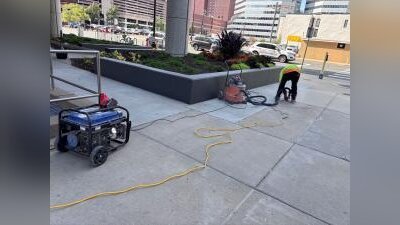
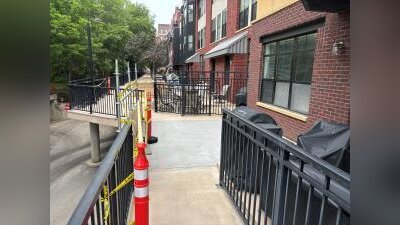
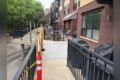
When your job site is an active airport runway for baggage tugs, there is no such thing as a simple renovation. That is the reality Western Specialty Contractors faced and ultimately mastered at Minneapolis-Saint Paul International Airport (MSP). The company’s Minneapolis branch has finished a major waterproofing restoration project, replacing roughly 23,000 square feet of traffic coating and waterproofing along the Terminal 1 Tug Drive.
The Tug Drive is not a casual roadway; it is a vital artery for airport ground crews, allowing baggage tugs to haul luggage to and from aircraft. Keeping this route fully functional during construction meant the work could not simply shut down operations. It required meticulous planning and constant coordination with a host of airport stakeholders.
Western worked as a subcontractor on the job. The first step was ripping out the old traffic coating and waterproofing system—which the company itself had originally installed back in the early 2000s—down to the bare concrete. From there, crews applied a brand-new, five-layer KEMPER waterproofing system engineered to stand up to water infiltration and the heavy wear and tear of airport ground operations for years to come.
Also worth a look: HandicapMD clarifies that non-drivers can get placards, no license needed and Western Specialty Contractors navigates dense foot traffic to patch concrete at Minneapolis Ameriprise tower.
The removal process itself threw up a major obstacle. In several spots, the original coating was nearly three-quarters of an inch thick, making extraction far tougher than anyone had anticipated. Western initially planned to use shotblasting and scarifying equipment to grind it away, but those methods proved ineffective against the stubborn material. To solve the problem, the company brought in a specialty subcontractor equipped with a ride-on milling machine, which successfully cut through the thick coating and prepped the concrete for the new system.
Beyond the chemical challenge, the biggest test was logistics. The entire 23,000-square-foot workspace was divided into nine separate zones, each of varying size. The rule was strict: each zone had to be fully finished before crews could move to the next one. This phased approach demanded intensive communication and scheduling with the Metropolitan Airports Commission (MAC), general contractor Sheehy, United Airlines, American Airlines, consultant Inspec, architect Alliiance, and airport project contractor Kraus-Anderson. Every zone carried its own completion deadline, forcing a constant balancing act between keeping airport operations running smoothly and giving crews enough time to remove the old system, prep the concrete, and install the new waterproofing.
“Working at an active airport presents a unique set of challenges, especially when the area being repaired is essential to daily baggage operations,” said Matt Drew of Western Specialty Contractors. “We had to coordinate with several different organizations to make sure each zone was completed before moving on to the next. When we discovered how difficult the existing coating was to remove, our team adapted quickly and found a solution that allowed us to keep the work moving and meet the required deadlines.”
Despite the coating surprises and the relentless schedule, Western successfully completed all nine zones according to the project’s phasing requirements. The work kicked off in April 2026 and wrapped up in October 2026, with the company meeting every deadline while keeping disruptions to airport operations to an absolute minimum.
David Grandbois
Minneapolis Branch Manager
+1 612-781-7100 x2612
Why it matters: This project demonstrates how specialized construction firms must adapt to the unique constraints of active transportation hubs, where a single missed deadline could ripple into flight delays. The successful removal of a nearly inch-thick coating also highlights the importance of anticipating material challenges in infrastructure renewal, a lesson relevant to any large-scale restoration at critical public facilities.