NY, UNITED STATES, September 12, 2026 /EINPresswire.com/ — King Faisal Specialist Hospital and Research Centre (KFSH) has shifted its CAR T-cell program from reliance on therapies produced overseas to an internally developed clinical and research operation. After starting the program using imported treatments in 2020, KFSH has cared for over 200 patients and, as of 2024, has been manufacturing genetically modified T cells on site to reduce the time between clinical choice and treatment.
CAR T-cell therapy involves taking immune cells from a patient's blood, genetically altering them to detect and destroy cancer cells, and then reintroducing them. Because each patient's own cells are used to produce the therapy, delivery timing becomes a clinical factor rather than just a logistical one: individuals with aggressive illnesses may worsen while their cells are transported, processed, and returned.
In 2024, KFSH started on-site manufacturing of genetically modified T cells. The procedure, which formerly required as long as 28 days when cells were dispatched overseas, now takes roughly 14 days at the hospital's specialized facility. Local production has also cut the treatment expense from around SAR 1.3 million to about SAR 250,000 per patient, while preserving cell viability and quality benchmarks.
This shift reached clinical application when KFSH administered the Kingdom's first locally manufactured CAR-T cells to a patient in a Phase I clinical trial for refractory acute lymphoblastic leukemia. The case combined patient selection, cell harvesting, local production, quality control, and specialist clinical care within a single institution, lowering the logistical risk created when a severely ill patient's cells must be transported abroad and then brought back.
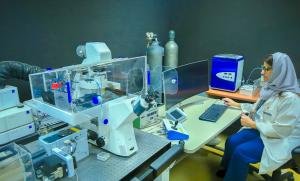
KFSH is advancing this capacity via the Kingdom's first dedicated center for manufacturing genetic and cellular therapies, situated on its Riyadh campus. Covering over 5,000 square meters and designed with 16 modular clean-room clusters that can adjust as treatment technologies evolve, the facility aims to produce CAR T-cell and stem-cell therapies and fulfill a significant portion of national demand for advanced treatments.
The economic rationale parallels the clinical one. Domestic manufacturing eliminates cross-border shipping dependencies, shortens the window between decision and therapy, and enables a health system to plan capacity instead of buying it on a case-by-case basis. The hospital has set a goal of expanding to 100 gene therapy procedures annually.
This effort aligns with the National Biotechnology Strategy, which intends to localize biotechnology sectors and establish Saudi Arabia as an international center for life sciences innovation by 2040. Advanced therapy manufacturing is among the topics KFSH will address at the C3 US NYC Davos of Healthcare™ Summit 2026 on September 14 in New York City.
King Faisal Specialist Hospital and Research Centre was ranked first in the Middle East and Africa and 12th globally among the world's top 250 academic medical centers for 2026. It was also named the most valuable healthcare brand in the Kingdom and the Middle East for 2026, according to Brand Finance, and listed by Newsweek among the World's Best Hospitals, World's Best Smart Hospitals, and World's Best Specialized Hospitals for 2026.
KFSH
Riyadh
email us here