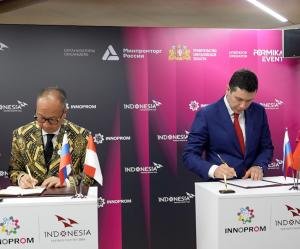
EKATERINBURG, RUSSIA, July 31, 2026 /EINPresswire.com/ — The Government of the Republic of Indonesia is actively working to broaden the sales network for its domestic industrial goods on the global stage. This strategic focus is clearly reflected in Indonesia’s prominent role as the official partner country at the INNOPROM-2026 international industrial exhibition, currently being held in Yekaterinburg, Russia.
“Indonesia presents a clear industrial agenda — accelerating industrialization based on raw material processing, from critical minerals and advanced manufacturing to energy, food security, and industrial parks,” stated Indonesia’s Minister of Industry, Agus Gumiwang Kartasasmita, during his address at the Business Forum “Russian-Indonesian Industrial Dialogue” in Yekaterinburg (July 7). He further noted that Indonesia is highly optimistic about deepening its technological partnership with Russia while integrating high-tech manufacturing into the Eurasian market.
The manufacturing sector continues to serve as the primary pillar and foundation of Indonesia’s national economy. According to Statistics Indonesia (BPS), the manufacturing industry posted positive growth of 5.04% in the first quarter of 2026, up from 4.55% in the same period a year earlier. Additionally, manufacturing contributed the largest share to Indonesia’s gross domestic product (GDP) — 19.07%, equivalent to 1,179.62 trillion Indonesian rupiah.
These strong figures were also mirrored in realized investment volumes for the first quarter of 2026: manufacturing accounted for 36.49% of total investment, amounting to 182.04 trillion rupiah. Beyond investment, the sector provided significant employment, covering 20.04 million workers as of February 2026. In international trade, manufactured goods made up 83.61% of Indonesia’s total exports from January to February 2026, with an export value of 622.68 trillion rupiah.
Economic ties between Indonesia and Russia have also shown notable progress in recent years. Total bilateral trade between the two nations grew by 5.4%, reaching US$4.8 billion in 2025. Indonesia’s exports to Russia rose substantially as well — by 7.5%, totaling approximately US$1.8 billion in 2025. Indonesia regularly exports key items such as rubber, coffee, cocoa, tea, footwear, electronic components, and chemical products. Meanwhile, Indonesia imports important goods from Russia, including fertilizers, iron, steel, grains, organic chemicals, and aircraft equipment.
Furthermore, the business forum addressed three main topics: joint industrial projects, investment opportunities for industrial companies in Russia and Indonesia, and tools and mechanisms to support exporters. “I am confident that today’s forum will enable both countries, especially the industrial sector, to establish concrete cooperation by initiating mutually beneficial and sustainable joint projects,” the Minister of Industry added.
To further strengthen this strategic partnership, both nations agreed to sign seven memorandums of understanding (MoUs) in the industrial sphere. These include a cooperation agreement between the Ministry of Industry of the Republic of Indonesia and the Ministry of Industry and Trade of the Russian Federation, along with five technical and commercial cooperation agreements involving industry representatives — among them the Indonesian Offshore and Shipbuilding Industry Association (IPERINDO), PT PCM Kabel Indonesia, PT Athira Maritim Indonesia, the Indonesian Association of Ship Component Manufacturers (PIKKI) together with the Ak Bars United Industrial Corporation, a memorandum between PT Minang Jordanindo and CHETRA LLC, and an MoU between the Indonesian Industrial Zones Association (HKI) and the Association of Clusters, Technoparks, and Special Economic Zones of the Russian Federation (AKIT RF). These new agreements build on two previously signed MoUs, effective since December 2025, in the areas of shipbuilding and chrysotile asbestos research.
Indonesia’s role as the official partner country is expected to provide a solid foundation for building a long-term, mutually beneficial partnership — for both Indonesia and Russia, as well as on a global scale — amid current geoeconomic and geopolitical challenges.
The District Communications
The District
email us here