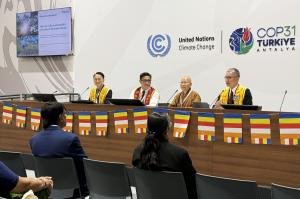
At a global climate conference often dominated by technical debates and political negotiations, a side event in Turkey offered a strikingly different approach: inner transformation as the foundation for environmental action. The Buddha’s Light International Association (BLIA) and India-based VIKALP co-organized an official side event at the 31st United Nations Climate Change Conference (COP31) on November 14, drawing nearly 200 participants both in person and online to examine how spiritual values and grassroots efforts can advance global sustainability.
An official UNFCCC side event highlights how Buddhist values, sustainable living, community engagement, and nature-based solutions inspire climate action.
Protecting our planet begins with a change of heart. Through compassion, mindful living, and collective action, we can turn Buddhist values into meaningful solutions for a sustainable future.”— Venerable Jue Pei, Secretary-General, BLIA
Also worth a look: New York bets $768K on local tree nurseries and tech to transform private yards into pocket forests and Dara Horn tells JNF-USA conference: Antisemitism is a lie, not just prejudice.
ANTALYA, ANTALYA, TURKEY, November 18, 2026 /EINPresswire.com/ — The session, titled “Sustainable Lifestyles to Global Impact: Integrating Nature-based Solutions, Community Engagement and Humanistic Values,” spotlighted the interlinked concepts of spiritual preservation (心保) and environmental preservation (環保). This philosophy, championed by Venerable Master Hsing Yun, the founder of Fo Guang Shan, frames care for the planet as inseparable from inner peace.
Venerable Miao Duo, Deputy Abbess of Fo Guang Shan Europe, opened the event by guiding attendees through a meditation, prompting them to consider how inner awareness connects to environmental responsibility. Roxanna Pang, Sumagadhi Lecturer of the BLIA WHQ Young Adult Division, then moderated a discussion that tied individual values and everyday decisions to broader collective environmental action.
Kwong Djee Chan, Deputy Director of the BLIA WHQ Lay Dharma Lecturer/Teacher Fellowship, laid out the Buddhist underpinnings of environmental stewardship. Drawing on principles of non-harming and dependent origination, Chan argued that all living beings are interconnected, making care for the environment a direct expression of compassion. He used an analogy comparing the Earth to the human body, urging participants to tend to mountains, forests, and rivers as they would their own health. Reinforcing Venerable Master Hsing Yun’s teaching that spiritual and environmental preservation are two sides of the same coin, Chan called on everyone to share the burden of creating a harmonious and sustainable world.
Ailun Wei, Deputy Director of the BLIA WHQ United Nations Committee, shifted the focus to practical, daily actions. He introduced BLIA’s “Five-Ring Linkage” framework, highlighting initiatives that encourage sustainable lifestyles. Among these are the Vege Plan A Programme, which promotes plant-based diets, and VEGRUN, a program linking physical activity to environmental awareness and community involvement. Wei demonstrated how routine choices about food and exercise can serve as tangible expressions of environmental values.
George Hu, Deputy Director of the BLIA WHQ Pure Green Sustainable Development Committee, presented the T-Earth reforestation initiative in Taiwan. Hu stressed that planting trees is only the first step; long-term ecological stewardship is the real goal. The initiative is built on three interconnected elements: Teamwork, Tea, and Trees. Teamwork unites local communities, including Indigenous Peoples, in restoration efforts. Tea provides income from native forest products to fund ongoing care. Trees help people reconnect with local biodiversity and make choices that support the natural environment. Hu also highlighted the critical role of scientific collaboration and monitoring to measure the initiative’s ecological impact, showing how restoration can simultaneously strengthen communities, support livelihoods, and conserve biodiversity.
Venerable Chueh Pei, Secretary-General of BLIA WHQ, joined the side event online and stressed the importance of bringing Buddhist environmental practices to international platforms. He encouraged continued dialogue and cooperation, noting how BLIA’s global network can drive climate action through community engagement and the practice of Humanistic Buddhism. Young participants also shared how Buddhist teachings shape their sense of personal responsibility and sustainable living. To close, Venerable Miao Duo led the room in reciting Venerable Master Hsing Yun’s Prayer for Our Natural Environment, reaffirming the bond between compassion, spiritual cultivation, and care for the natural world.
The side event underscored that personal transformation, community participation, and sustained collective action are essential to addressing climate change and biodiversity loss. By weaving together Buddhist wisdom, scientific knowledge, and practical environmental initiatives, BLIA reaffirmed its commitment to putting Humanistic Buddhist values into practice.
Why it matters: This event demonstrates that religious and spiritual organizations are becoming serious players in international climate diplomacy, offering frameworks that go beyond policy to address the human motivation behind environmental action. By linking inner change to outer stewardship, BLIA provides a model that could inspire other faith-based groups to translate their core values into measurable ecological impact.
George Hu
BLIA