When a punishing Texas dry spell finally breaks, homeowners might think the worst is over. But for houses across Tyler and Smith County, the arrival of rain can actually introduce a new set of risks beneath the foundation. Local foundation repair company Risen Home Leveling is drawing attention to a little-understood pattern: wet weather after severe drought can trigger uneven soil movement that is just as troublesome as the dry conditions that preceded it.
As Jesse Reynolds, owner of Risen Home Leveling, puts it: “A good rain ends a dry spell, but it doesn’t put a house back where it was. What matters is how the soil under each home responds, and that’s different from one lot to the next.”
The warning comes after a dramatic weather swing in the region. The Smith County Commissioners Court prohibited outdoor burning on August 18, 2026, as drought conditions intensified. A local emergency services official described the situation to KLTV as a “flash drought” following more than 30 consecutive days without rain. That ban was finally lifted on October 5, 2026, after the National Weather Service recorded 0.95 inches of rain across the county from October 2 through October 4, according to the Tyler Morning Telegraph.
Also worth a look: Woven Health Collective wins gold for VR tool that helps doctors spot a tricky heart condition and HandicapMD guide tackles vision and parking placard myths beyond driving and wheelchairs.
Smith County relies on the Keetch-Byram Drought Index to track dryness, a 0-to-800 scale that estimates how much rainfall is needed to restore full moisture to upper soil layers. The county’s average reading sat at 717 the week before the burn ban was lifted, dropping to 541 by October 5. Each point on this index represents one-hundredth of an inch of moisture deficit, meaning that even a reading of 541 still corresponds to a shortfall of roughly 5.4 inches. While the index was originally designed to assess wildfire risk rather than foundation stability, it highlights a crucial reality: a single wet weekend can improve surface conditions while deeper soil remains severely parched.

The broader picture is equally stark. NOAA climate data published on the federal Drought.gov portal shows that January through June 2026 ranked as the 11th-driest such period in Smith County’s 132-year recorded history. Statewide, roughly 60 percent of Texas was classified as experiencing drought on the U.S. Drought Monitor assessment valid November 3, 2026.
Forecasters had already warned about how parched ground would react to a sudden soaking. Carly Kovacik, a meteorologist with the National Weather Service office in Shreveport, told the Tyler Morning Telegraph ahead of the early-October rains that soils were “so dry right now that the rain’s probably going to run off very quickly.” She noted that the rain would ease the region’s drought without breaking it entirely.
After a late-summer dry spell, returning rain may bring uneven soil movement beneath slab and pier-and-beam homes in Tyler and Smith County.
It is important to note that these weather and soil-moisture figures do not document any actual increase in foundation damage across Tyler or Smith County. No public data reviewed for this report shows a local rise in foundation failures. The concern is grounded in a well-understood geological mechanism—one that affects each property differently depending on soil type, drainage, construction methods and surrounding vegetation.
TYLER-AREA SOILS VARY FROM LOT TO LOT
Soils in the Tyler area are far from uniform, and it would be misleading to claim every local home sits on highly expansive clay. The U.S. Department of Agriculture’s soil survey of Smith County maps a broad range of soil types. Many upland soils feature sandy or loamy surface layers over subsoils that range from loamy to clay-rich. Some clay-bearing layers shrink and swell noticeably as moisture fluctuates, while others are far less reactive. Property owners can research the soils mapped on their specific parcel through the USDA’s free Web Soil Survey, though a soil map serves as a general guide rather than a definitive site-specific test.
The shrink-swell behavior comes from the clay minerals themselves. Certain clays absorb water and expand, then contract as they dry out. When this happens beneath a house, the movement is rarely uniform because moisture levels rarely change evenly across the entire footprint of a structure.
Soil beneath the middle of a slab remains shaded and covered year-round. Soil at the edges, however, is exposed to sun, wind, tree roots, roof runoff and lawn irrigation. These differences between zones tend to produce uneven movement, which is more consequential than whether the ground is simply wet or dry.
Construction type and landscaping choices also play a major role. Two neighboring houses on similar soil can respond very differently for several reasons:
- One sits on a concrete slab while the other rests on piers.
- One lot drains effectively while the other holds water.
- Large trees draw moisture from one side of a home but not the other.
Tyler’s housing stock includes both older pier-and-beam houses and newer slab-on-grade construction, meaning local homeowners may encounter either set of concerns.
WHAT HAPPENS DURING DRY WEATHER
During an extended dry period, moisture-sensitive clay loses water and contracts. Soil can pull away from the edge of a foundation, leaving a visible gap. The ground beneath part of a structure may also drop slightly relative to the rest of the foundation.
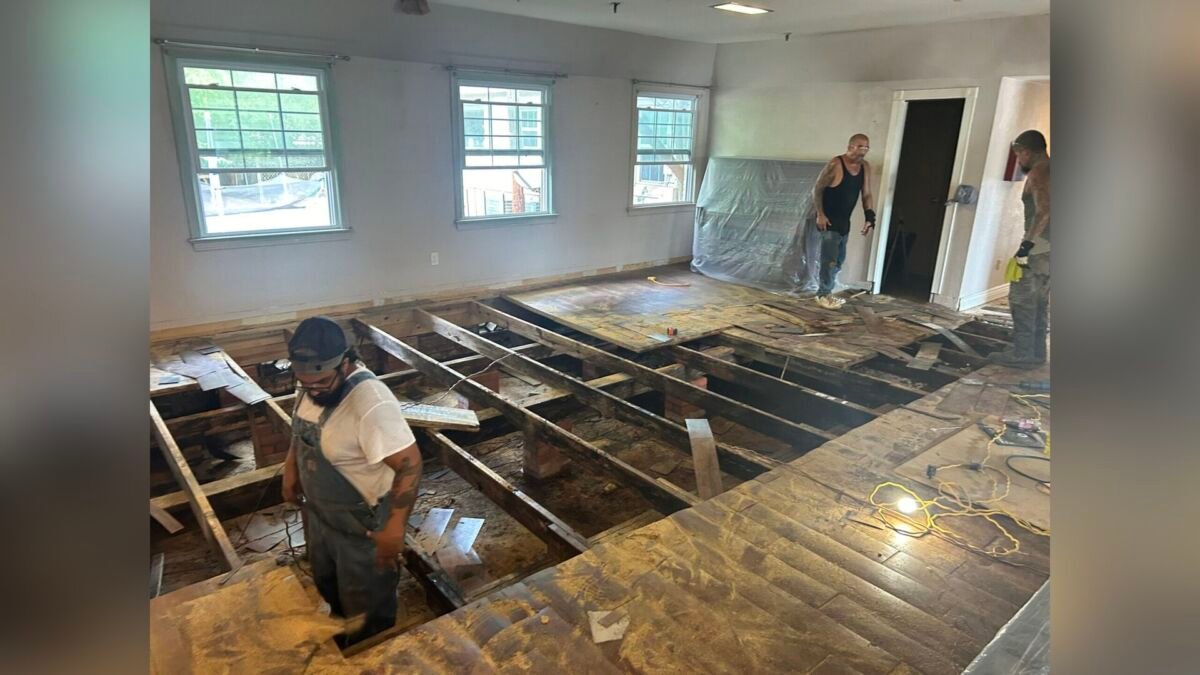
For a concrete slab, this can leave some sections less evenly supported than others. For a pier-and-beam home, the shallow piers or pads that rest on footings can settle at different rates. Inside the house, the typical signs are floors that slope or doors that drift out of alignment.
WHY THE EDGES OF A HOUSE OFTEN CHANGE FIRST
Because the perimeter of a home is the part most exposed to weather, it is usually where soil moisture changes earliest and most dramatically. During a long dry spell, soil along the outside edges can lose moisture faster than soil beneath the center of the house. The edges may then sit lower relative to the interior, a pattern sometimes called edge drop.
When rain returns, the order can reverse. Water reaches the perimeter first, and susceptible soil there may swell before moisture works its way inward. A house that moved one direction during the summer may see its edges shift the other direction after a series of storms, and that movement does not necessarily retrace the same path.
Trees add another layer of complexity. Mature trees planted close to a house can draw significant moisture from the soil around their roots, and that demand rises in hot, dry weather. After rain, the soil near those trees may recover on a different schedule than soil on the open side of the lot. That difference can produce movement concentrated near one corner or one wall rather than across the entire structure.
WHAT CHANGES WHEN HEAVY RAIN RETURNS
When heavy rain arrives after a long dry spell, three separate processes can follow:
- Susceptible clay can swell as moisture returns. Water reaches some areas, such as a foundation’s perimeter or a low corner of the lot, before it reaches others, so that swelling can be uneven.
- Intense rainfall on hard, dry ground tends to run off rather than soak in. Concentrated runoff from roofs, driveways and slopes can wash soil away from the edge of a foundation.
- Where grading, clogged gutters or short downspouts send water toward a house, water can collect along the foundation or in the crawl space beneath a raised floor.
Rain does not necessarily reverse existing damage. A section of slab that settled during the summer will not automatically lift back to its earlier position, and cracks that opened during dry months do not reliably close. Re-wetting can also move soil in a different pattern than drying did, meaning a home may go through a second round of adjustment rather than returning to where it started.
WHY CHANGES CAN UNFOLD SLOWLY
Soil moisture does not reset overnight. Surface layers respond to a storm within hours, but water moves into deeper clay more gradually, and a single rain event may wet only the upper part of the soil profile. This is one reason a soil-moisture index can remain elevated even after a noticeable rain.
For homeowners, the practical effect is that any foundation response to a wet season may develop over weeks or months rather than immediately after a storm. A door that closes normally the day after a heavy rain may behave differently later in the winter or the following spring. Comparing conditions across a full season gives a much clearer picture than judging a house by a single week.
SLAB AND PIER-AND-BEAM HOMES RESPOND DIFFERENTLY
For homes built on concrete slabs, the slab is one continuous structural unit. Differences in soil movement beneath it place stress directly on the concrete. That stress can contribute to cracking in the slab and in finishes above it, such as tile and drywall, and to measurable changes in floor elevation from one part of the house to another.
Risen Home Leveling, a Tyler company that provides house leveling and foundation repair, notes in its published service information that slab problems generally fall into three patterns: settling, heaving and cracking. The company’s materials also explain that a crack caused by soil movement must be distinguished from ordinary shrinkage cracking that forms as concrete cures, because only the first calls for structural work.
Slab homes carry an added consideration because plumbing lines typically run beneath the concrete rather than through an accessible crawl space. The company’s published materials note that movement in a slab can stress the pipes buried beneath it, and that a slow leak from a damaged line can add moisture to the surrounding soil and worsen the movement that caused it. An unexplained wet area, a rise in a water bill or the sound of running water when fixtures are off can point to a leak worth investigating separately from any rainfall.
Pier-and-beam homes, which the company describes as one of the most common foundation types in East Texas, face two related but separate concerns:
- Support movement. The shallow piers and footings that carry the floor framing can move, producing uneven, sloping or bouncy floors.
- Crawl-space moisture. Water that pools beneath a raised floor, or humidity that lingers after repeated storms, can affect wooden beams, joists and subflooring over time. This can happen whether or not the piers themselves have moved.
Manufactured homes face similar questions. Many rest on piers or blocks set on or near the ground surface, so changes in the soil under those supports can affect how level the home sits. After a wet period following drought, owners may notice the same signs seen in site-built homes, including sticking doors, new gaps at trim and floors that feel uneven.
SIGNS WORTH NOTING, AND WHAT THEY DO NOT PROVE
Homeowners commonly notice movement through everyday changes:
- New wall cracks, or existing cracks that appear to be widening, especially near the corners of doors and windows
- Doors or windows that begin sticking or no longer latch
- Noticeable changes in how a floor slopes
- Gaps opening around trim, baseboards or cabinets
- Soil pulling away from the foundation’s edges
- Water standing near the house after rainfall
These signs warrant attention, but none of them independently establishes structural failure or identifies its cause. Sticking doors can result from seasonal humidity. Small cracks in drywall or concrete can come from ordinary shrinkage.
A qualified evaluation typically considers how conditions change over time and how they are distributed across the house. Risen Home Leveling’s published materials describe using elevation mapping before recommending a repair approach. Elevation mapping measures relative floor heights at points throughout a structure, which helps show where movement is concentrated.
PRACTICAL STEPS DURING THE WET SEASON
Several simple habits help homeowners manage water around a foundation and build a useful record:
- Keep gutters clear. Clean out leaves and debris, particularly after fall leaf drop, so roof water travels where it was designed to go.
- Direct downspouts away from the house. Downspouts should discharge away from the structure rather than at the base of the foundation. Extensions or splash blocks can carry water farther out.
- Observe drainage during a storm. Heavy rain is when drainage problems are easiest to see. Note where water flows, where it pools, and whether it moves toward or away from the house.
- Check the slope of the ground. The International Residential Code, a model code widely used as the basis for local residential building rules, calls for ground next to a foundation to slope away from it, generally falling at least 6 inches within the first 10 feet where site conditions allow. Settled soil, raised flower beds and landscape edging can change that slope over time.
- Document changes with dated photographs. Photograph cracks, gaps and door frames from the same angle each time, with a ruler or coin for scale. This makes it possible to compare conditions over weeks or months rather than relying on memory.
Homeowners should be cautious about generic watering advice. The right approach to soil moisture around a foundation depends on the soil, the foundation type and the site. Adding large volumes of water to gaps that open beside a foundation can saturate soil unevenly or send water beneath the structure. Questions about moisture conditions at a specific property are best addressed by a qualified professional who has examined the home.
WHAT A FOUNDATION EVALUATION TYPICALLY INVOLVES
Homeowners who decide to have a house evaluated may encounter two kinds of professionals. Foundation repair contractors assess and correct movement, while licensed professional engineers can provide an independent structural assessment. In Texas, engineers are licensed through the Texas Board of Professional Engineers and Land Surveyors.
Whichever route a homeowner chooses, a useful evaluation generally documents what was measured, where and when. Records such as floor elevation readings, notes on drainage and a written explanation of the suspected cause give homeowners something concrete to compare against later observations. Dated photographs taken by the homeowner over the preceding months can also help an evaluator distinguish recent movement from long-standing conditions.
Why it matters: For homeowners across East Texas, the takeaway is clear: the end of a drought does not mean the end of foundation concerns. Understanding how soil, drainage and construction interact can help property owners spot early warning signs and take practical steps before minor shifts become major repairs. With much of Texas still in drought and seasonal rains returning, the coming months could reveal just how much the dry summer of 2026 has reshaped the ground beneath local homes.
ABOUT RISEN HOME LEVELING
Risen Home Leveling is a family-owned house leveling and foundation repair company based in Tyler, Texas, and owned by Jesse and Angel Reynolds. The company provides pier-and-beam foundation repair, slab foundation repair, manufactured home leveling, crawl space repair and related structural services for residential and commercial properties. It serves Tyler and East Texas communities including Longview, Kilgore, Canton, Athens and Lindale. Risen Home Leveling is located at 9610 CR 21, Tyler, TX 75707, and can be reached at (903) 422-1538. More information is available at https://risenhomelevelingtx.com/.
Jesse Reynolds
Risen Home Leveling
+1 (903) 422-1538
Risenhomeleveling@gmail.com
Visit us on social media:
Facebook