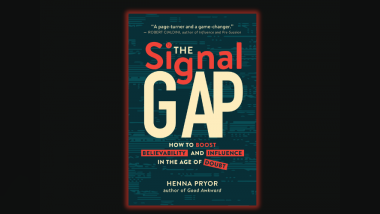
The real threat to workplace trust isn’t that people have become more dishonest — it’s that audiences have grown more suspicious, and that mismatch is quietly eroding influence. That is the provocative argument at the heart of Henna Pryor’s new book, The Signal Gap, which landed with a Kirkus Starred Review and a spot on the Next Big Idea Club’s Monthly Must-Read list for its launch month.
Pryor, a Philadelphia-based workplace performance expert and a leading voice on believability in the age of AI, released her second book on November 10, 2026. Published by Ideapress Publishing and distributed by Simon & Schuster, The Signal Gap: How to Boost Believability and Influence in the Age of Doubt tackles the growing challenge of building trust when audiences assume every communication has been touched by a machine.
The research that reframes the conversation
Also worth a look: The Radiology Group takes on Florida’s rural imaging crisis with new WeCARE platform and Nkuringo Eco Collection adds Marafiki Safari Lodge, linking Uganda’s top wildlife regions in one trip.
Two 2026 studies sharpen the argument at the center of Pryor’s book and complicate what most leaders believe they are solving for. In the first study, published in the Journal of Experimental Social Psychology, Martuza and colleagues ran 11 experiments with more than 8,000 participants and found that people overestimate how often others will cheat for personal gain by nearly 14 percentage points. When participants were shown accurate data on how honestly others had actually behaved, their expectations improved. Managers given the same accurate data reported less support for workplace surveillance.
“We’ve been telling leaders that trust is collapsing,” said Pryor. “The research tells a different story. People are not more dishonest. Audiences are more suspicious — and the gap between what we assume others will do and what they actually do is what’s quietly breaking workplace trust. That is a believability problem, not a character problem.”
A second 2026 study, from Nguyen and colleagues in the Journal of Leadership and Organizational Studies, tracked 78 teams across 27 organizations and found that how authentic a leader feels has no reliable connection to whether employees see that leader as walking the talk.
“You can mean every word and still give people good reason to doubt you,” Pryor said. “‘I meant it’ and ‘they had good reason to believe it’ are two different problems. Most leaders are solving the first one. The second one is where influence actually lives.”
Introducing the Signal Gap
Pryor calls this phenomenon the Signal Gap — the growing distance between what a leader or seller intends to communicate and what their audience is willing to believe. The book argues that in what Pryor calls the Verification Era, audiences verify first and trust later, if at all.
The Signal Gap introduces Signal Integrity — the alignment of message, tone, behavior, and context that determines whether a leader, seller, or communicator is believed — along with the P0 Rule, Skill Zero (the disarm), and the principle that every post is a promise. The book carries endorsements from Robert Cialdini, Daniel Pink, Dorie Clark, Tasha Eurich, and 14 others, with primary interviews from Cialdini and other named experts.
The Signal Gap keynote is booking now for Q1 and Q2 2027 sales kickoffs, revenue offsites, and leadership summits. Inquiries at www.pryoritygroup.com.
Questions for reporters and analysts
Q: What is the Signal Gap?
The Signal Gap is the growing distance between what a leader or seller intends to communicate and what their audience is willing to believe. Pryor argues this gap has widened in the Verification Era, when audiences verify first and trust later.
Q: What does the new research say that is different?
People are not actually more dishonest. Audiences overestimate how dishonest others will be, and leaders feeling authentic does not mean their teams see them as walking the talk. Both are believability problems.
Q: Who is Henna Pryor?
Henna Pryor is a workplace performance expert, keynote speaker, and author of The Signal Gap (Ideapress Publishing, November 2026). She is a leading voice on believability in the age of AI.
About Henna Pryor, CSP
Henna Pryor is a Workplace Performance Expert, keynote speaker, and leading voice on believability in the age of AI. She founded Pryority Group to help sales teams and leaders close the gap between how they show up and how they’re believed. Her first book, Good Awkward, is one of Kirkus Reviews’ Best Books and earned 18 awards. She is a 2x TEDx and 2x SXSW speaker, Certified Speaking Professional (CSP), Inc. Magazine columnist, and LinkedIn Learning instructor. Learn more at www.pryoritygroup.com.
Media contact
media@pryoritygroup.com
Team Pryority Group
Pryority Group
Visit us on social media:
LinkedIn
Instagram
YouTube
Why it matters: The research Pryor highlights suggests that many corporate trust-building efforts may be aimed at the wrong target — fixing honesty when the real problem is audience perception. For leaders and sales professionals navigating an era of AI skepticism, closing the Signal Gap could become as critical as closing a sales deal.