Attendees from multiple nations gathered for a group photo at the side event ‘Heritage in Action for Sustainable Development,’ which took place during the 48th session of the World Heritage Committee in Busan on July 22 2026
On July 22, BEXCO (Busan Exhibition & Convention Center) hosted the side event ‘Heritage in Action for Sustainable Development,’ organized as part of the 48th session of the World Heritage Committee.
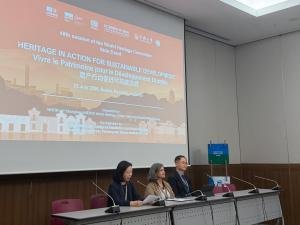
Community-driven conservation, digital reconstruction and neighborhood renewal along Nanjing's Ming City Wall are highlighted through a case presentation and digital exhibition
Bring Every Brick Home Project repairs memory by looking to the past, while Digital Heritage That Never Disappears constructs imagination for the future”— Wang TengBUSAN, SOUTH KOREA, July 22, 2026 /EINPresswire.com/ — During the 48th session of the World Heritage Committee in Busan, Republic of Korea, Nanjing—the capital of eastern China’s Jiangsu province—unveiled its methods for participatory heritage conservation and sustainable urban growth.
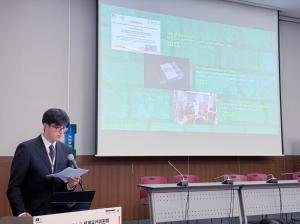
The Nanjing-hosted program, called “Shared Heritage, Shared Future,” featured a conservation and co-creation case presentation along with “Our Wallscapes,” a digital exhibition comprising four short films. Together, these components explored how the Ming City Wall and adjacent historic neighborhoods are being preserved and woven into modern city life.
This presentation was part of a side event focused on heritage action for sustainable development. Co-organizers included the World Heritage Institute of Training and Research for the Asia and the Pacific Region under the auspices of UNESCO (WHITR-AP), Shanghai Centre, the UNESCO World Heritage Centre, UN-Habitat and ICOMOS Korea. Content contributions came from the Nanjing International Communication Center.
During the meeting, the institute, Whitrap-shanghai,the UNESCO World Heritage Centre and UN-Habitat introduced the five-year Heritage Hub initiative spanning 2026–30. The initiative aims to foster collaboration on heritage conservation and development in both urban and rural contexts.
“Nanjing has extensive and creative experience in connecting cultural heritage conservation with sustainable urban development,” stated Shao Yong, secretary-general of the institute and director of its Shanghai center. She expressed hope that Nanjing would become a key partner in the five-year initiative.
This year marks 660 years since construction of the Nanjing Ming City Wall began. Wang Teng, an associate researcher at the Nanjing City Wall Museum, described two projects developed under the “Shared Heritage, Shared Future” global co-creation effort.
The first, the “Bring Every Brick Home Project,” launched in 2016. Local residents, community workers and volunteers assist in locating, verifying and recovering inscribed Ming-era bricks scattered across the city. According to project organizers, by the end of 2025 the program had visited over 500 recovery sites and collected nearly 600,000 bricks.
The second, the “Digital Heritage Global Innovator Contest,” employs digital design to reinterpret the Porcelain Tower of Nanjing—a landmark at the Great Bao'en Temple that no longer stands. Two editions of this museum-based maker program have engaged more than 1,000 young participants from 19 countries, resulting in augmented reality works, immersive audio pieces and digital installations displayed in the museum.
“Bring Every Brick Home Project repairs memory by looking to the past, while Digital Heritage That Never Disappears constructs imagination for the future,” Wang said. “Together, they form a complete picture of Nanjing's participatory conservation practice through the recovery of memory and the renewal of cultural imagery.”
Doo-Won Cho, an executive committee member of ICOMOS, described Nanjing's city wall conservation as a valuable model for similar heritage sites around the world.
The accompanying “Our Wallscapes” exhibition expanded the discussion through four films. One documents the city brick recovery program. A second follows a 12-year lantern tradition in the Laomendong historic district. A third explores international and interdisciplinary reinterpretations of the Porcelain Tower. The fourth examines the incremental renewal of Xiaoxihu, where residents, government officials, designers, business owners and project implementers work together to preserve historic lanes and courtyards while enhancing living conditions.
Jae-Heon Choi, president of ICOMOS Korean, noted that both Nanjing's Ming City Wall and Korea's Hwaseong Fortress in Suwon are urban heritage sites facing similar conservation and governance challenges. He expressed willingness to explore multilevel conservation and management approaches with Nanjing.
Construction of the Nanjing City Wall began in 1366 as part of a four-section defensive system. Approximately 25.1 kilometers (15.6 miles) of the capital city wall remain. Today, the wall serves as both historic infrastructure and a public space for residents and visitors.
Andy Yan
North Professional Consulting Corp.
email us here