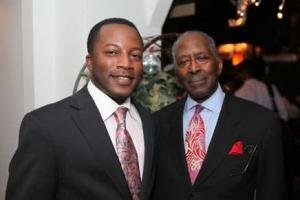
Bankole Thompson (right) with the late U.S. Sixth Circuit Court of Appeals Judge Damon J. Keith (left) and Thomas Perez (center), then Assistant Attorney General for Civil Rights at the U.S. Department of Justice, at a civil-rights forum Thompson moderated.
Thompson’s Forthcoming “12 Moral Questions” Reaches Back to Conversations with a Legendary Federal Judge, an Influential Black Publisher and a Young Editor
DETROIT, MI, UNITED STATES, September 2, 2026 /EINPresswire.com/ — Years before Bankole Thompson began scrutinizing the American experiment at the 250-year mark, Saturday evenings in Detroit brought together three men from different institutions and generations for conversation.
There was Judge Damon J. Keith, the celebrated federal judge and civil‑rights icon whose life was intertwined with many of the defining constitutional battles of modern America.
There was Sam Logan, the late publisher of the Michigan Chronicle, remembered as one of the most influential Black newspaper publishers of the last half‑century in the United States.
And there was Bankole Thompson, then the young, bold, innovative and courageous editor of the Chronicle, forging a strongly independent editorial voice that would later shape more than twenty years of journalism, books, and public commentary.
The gatherings often took place in Logan’s apartment. The judge, the publisher, and the editor discussed race, journalism, politics, civil rights, Detroit, leadership, power, and America.
More than two decades later, Keith and Logan have passed away. But Thompson says the intellectual legacy of those exchanges endures and now informs his upcoming seventh book, “Bankole Thompson’s 12 Moral Questions: Frederick Douglass and the Soul of America at 250.”
“I understand those Saturday evenings differently today,” Thompson said. “Judge Keith and Sam Logan came from a consequential era. They had confronted institutions, watched America change and understood that democracy ultimately depends upon what people entrusted with power are prepared to defend. I was the younger man in the room listening, questioning, sometimes debating and learning.”
KEITH, THE CONSTITUTION AND AMERICA’S BICENTENNIAL
Keith’s involvement in a book focused on America at 250 carries a striking historical symmetry. In 1987, Keith served as national chairman of the Judicial Conference Committee on the Bicentennial of the Constitution, guiding the federal judiciary in commemorating 200 years of the document that had defined—and often exposed—the contradictions within the American experiment.
Nearly four decades later, Thompson is examining many of those contradictions as the United States observes 250 years since the Declaration of Independence. For Thompson, the link between 1987 and 2026 is impossible to overlook.
“Judge Keith was entrusted with helping the judiciary reflect upon the Constitution at its bicentennial,” Thompson said. “Now America has reached another historic threshold. I find myself asking what the country has done with the promises that men like Keith spent their lives insisting must belong to everyone.”
Keith brought to those Saturday conversations not only the authority of a federal judge, but also the perspective of a Black jurist who understood that constitutional language means little if institutions lack the courage to enforce its promises.
SAM LOGAN AND THE POWER OF THE BLACK PRESS
Logan represented another institution essential to the Black freedom struggle: the Black press. As publisher of the Michigan Chronicle, Logan belonged to a generation of Black publishers who saw newspapers as more than businesses. They were institutions through which communities challenged power, interpreted events, and demanded recognition from a nation that frequently marginalized their voices.
Thompson regards Logan as one of the last great Black publishers of the past 50 years in America. Their relationship was not defined by constant agreement. As editor, Thompson sometimes took independent positions that generated disagreement and pressure. Yet Logan defended the institutional independence of his editor.
“Sam and I did not always agree, and that is precisely why his example matters,” Thompson said. “He understood that an editor who is independent only when the publisher agrees with him is not independent at all.”
The lesson survived Logan. Freedom is easiest to defend when it costs nothing. The real test comes when independence becomes inconvenient.
A GENERATION RECEDES
Keith died in 2019. Logan died in 2011. Their absence has taken on greater meaning for Thompson as other figures who helped shape his own intellectual and moral witness of civil rights and moral leadership have also passed from the scene. His longtime mentor, Rev. Dr. Bernard LaFayette Jr., the Freedom Rider, Selma movement leader and close associate of Rev. Dr. Martin Luther King Jr., died earlier this year.
Most recently, Thompson delivered the eulogy for Dr. William G. Anderson, the 98-year-old pioneering physician, Albany Movement leader and King-era civil rights figure, at Anderson’s August 25 homegoing service after being entrusted with the responsibility by Anderson’s family.
For Thompson, Keith, Logan, LaFayette and Anderson belonged to a disappearing world of witnesses whose encounters with American democracy were not theoretical. They had lived its contradictions.
“The danger is that consequential people become photographs on walls while the questions they wrestled with disappear with them,” Thompson said. “Memory must demand something of us. We have to ask what they knew, what they defended, what they challenged and what they have left for us to do.”
THE CONVERSATIONS SURVIVED THE ROOM
Frederick Douglass stands at the moral center of Bankole Thompson’s 12 Moral Questions, which examines democracy, truth, racial and economic justice, leadership, human dignity and what America owes its next 250 years.
But the book also reaches into Thompson’s own journey through journalism and public life.
He is deliberately declining to disclose precisely which conversations with Keith and Logan enter the book or where readers will encounter them.
“Some conversations belong first to the book,” Thompson said.
Retired Chief U.S. District Judge Gerald E. Rosen, former Chief Judge of the Eastern District of Michigan and chief judicial mediator in Detroit’s historic municipal bankruptcy, has already endorsed 12 Moral Questions. Other leaders and thinkers are reviewing the manuscript as it moves toward a limited advance edition in November 2026 and broader publication in February 2027.
Once, three men sat together on Saturday evenings talking about America. One had helped the nation commemorate 200 years of its Constitution. Another belonged to a formidable tradition of independent Black publishers. The third was a young editor asking questions.
The judge is gone.
The publisher is gone.
The editor kept asking questions.
And now, as America marks 250 years, Bankole Thompson is carrying some of those questions into the next room.
About Bankole Thompson
Bankole Thompson is a nationally acclaimed journalist, author, columnist and public intellectual whose work for more than two decades has examined democracy, racial and economic justice, poverty, leadership and the moral responsibilities of power.
He is a twice-weekly opinion columnist at The Detroit News, host of Bankole’s Nation, founder and chairman of The PuLSE Institute and founder of the Bankole Thompson Center. He previously served as editor of the Michigan Chronicle and is the first journalist in American history to serve on the National Board of Directors of the Southern Christian Leadership Conference, the civil rights organization founded and led by Rev. Dr. Martin Luther King Jr.
In 2015, the University of Michigan Bentley Historical Library established The Bankole Thompson Papers. His 2023 book, Fiery Conscience, was reviewed by Forbes and is listed in the Schomburg Center for Research in Black Culture.
“Bankole Thompson’s 12 Moral Questions: Frederick Douglass and the Soul of America at 250” is his seventh book.
BANKOLE THOMPSON
The PuLSE Institute
email us here