A new survey of 3,000 young Americans finds a generation that shows up and performs but keeps one foot out the door — with consequences for retention, AI security, and how companies plan for talent.
Fewer than half of Gen Z workers feel genuinely committed to their current employer, and a growing share now describe their relationship with work in the language of modern dating: functional, convenient, and decidedly non-exclusive.
That’s the central finding of a new survey of 3,000 Americans aged 18 to 28 conducted by PapersOwl, which identifies what researchers are calling the “job situationship” as the defining workforce dynamic of 2026.
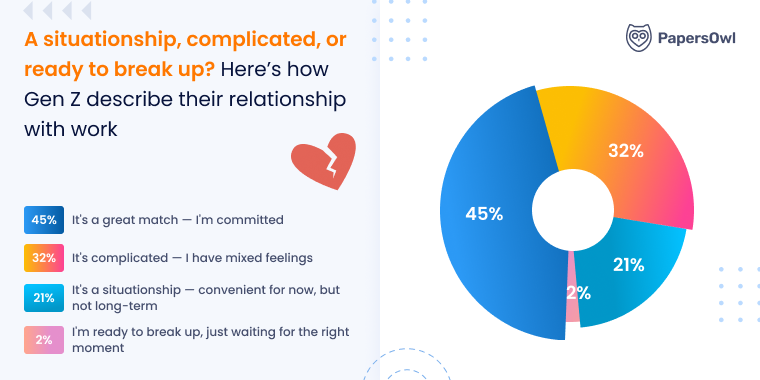
Asked to characterize their relationship with their current job, just 45% said it was a strong match they were committed to keeping. Nearly a third, 32%, called it “complicated.” Another 21% described it outright as a situationship — they show up and do the work, but no long-term commitment is implied. A further 2% said they were already on their way out, waiting only for the right moment to leave.
“What we’re seeing is not disengagement — it’s conditional engagement,” said Oryna Shestakova, Head of Communications at PapersOwl. “Gen Z workers are performing. They’re hitting their targets. But they have recalibrated their emotional investment in their employers, and the data shows exactly what it would take to change that.”
What it would take, according to the survey, is mostly money. 67% of respondents said only a major pay raise would persuade them to commit to their current employer for three years or more. Culture initiatives, perks, and purpose-driven messaging barely moved the needle on whether they intended to stay.
The study also surfaces a quieter shift that may worry employers more: how this generation uses AI. 59% said they had used AI tools at work without telling their employer — a practice with direct implications for data security and compliance.
“Young workers aren’t hiding AI use because they think it’s wrong,” Shestakova said. “They’re hiding it because they’ve learned that employers tend to react to new tools with restriction rather than adaptation. Organizations that build adaptive, employee-facing AI policies will see better compliance and better outcomes than those that rely on blanket restrictions.”
That assessment is echoed by specialists outside the study. “The number that should worry leadership isn’t that 59% are using AI quietly — it’s that the productivity is already baked into their output, and most companies have no visibility into where their data is going,” said Harry Southworth, Head of AI Development at Getsolved.ai. “You can’t govern what you’ve pushed underground. The organizations getting this right aren’t the ones writing the strictest policies — they’re the ones giving people sanctioned, secure tools good enough that there’s no reason to reach for an unmonitored one.”
Other findings point to a workforce quietly hedging its bets. 37% said they would begin a silent job search the moment layoff rumors surfaced, without flagging it to a manager or HR — suggesting the early-warning signs employers rely on may no longer offer much lead time. 65% believe remote workers get passed over for promotions, yet many keep working remotely anyway, knowingly trading advancement for flexibility. And the posture is no longer confined to junior staff: 38% of these Gen Z workers already manage at least one direct report.
For employers, the situationship dynamic is less a morale problem than a structural risk. A conditionally engaged workforce performs reliably when conditions are stable but is prone to rapid attrition the moment uncertainty sets in — and with more than a third ready to quietly start looking at the first sign of trouble, companies with weak internal communication stand to lose talent exactly when they can least afford to.
The flip side, the researchers note, is that the fix is known and largely within reach. Competitive pay, real flexibility, clear paths to advancement, and honest leadership during uncertain periods are the main levers that turn situationship employees into committed ones — and none require a structural overhaul.
The full report is available on the PapersOwl website.