For radiologists drowning in dictation corrections and repetitive normal findings, TurboRad’s free demo at RSNA 2026 offers a potential lifeline: a web-based reporting platform that promises to cut report generation time by up to 60%.
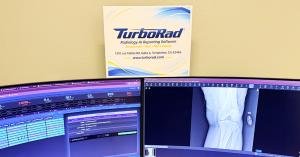
TurboRad Radiology AI Reporting Software Dual-Monitor Workstation with PACS Knee X-Ray. TurboRad delivers web-based radiology workflow innovation and structured radiology reporting software built to accelerate diagnostic radiology productivity.
Radiologists can test TurboRad’s web-based structured reporting tools during exhibit hours at McCormick Place, Chicago, November 29–December 2.
Also worth a look: BYD’s 80% in-house production gives it a $2,369-per-car edge over Tesla, study finds and DERCHI leads 10 aluminium door makers reshaping global residential construction in 2026.
I spent years watching good radiologists lose hours to the keyboard and the mic instead of the image. The bottleneck was never the doctor’s knowledge.”— Dr. Stephen Holtzman
TEMPELTON, CA, UNITED STATES, November 27, 2026 /EINPresswire.com/ — Radiologists heading to the Radiological Society of North America’s 112th Scientific Assembly and Annual Meeting can get a hands-on look at a reporting tool designed to tackle one of the field’s most persistent frustrations. At TurboRad’s Booth #4065 in McCormick Place, attendees can schedule a private, one-on-one demo of the company’s web-based structured radiology reporting software. These free sessions run during exhibit hours from November 29 through December 2, 10 a.m. to 5 p.m. CT, and are open to practicing radiologists, imaging directors, and leaders from teleradiology networks, independent private groups, freestanding outpatient centers, hospital departments, and women’s and breast imaging practices. During the demo, radiologists can work through different exam types using TurboRad’s button-based reporting and AI-assisted dictation, customise their reporting templates, and see how the platform tracks productivity in real time.
The real challenge in most U.S. reading rooms today isn’t spotting the abnormality. It’s finishing the report without losing the next hour to mechanical work. Imaging volumes have climbed steadily while the number of radiologists available to read reports has remained stagnant. On a busy shift, a radiologist may dictate nearly identical normal language for chest CTs or screening mammograms dozens of times, then pause to correct a speech engine that rendered “no acute findings” as “new acute findings.” Windows stack up. Manual edits accumulate. By late afternoon the cognitive load is significant, turnaround times stretch, and the radiologist still has studies left. The images themselves are rarely what slows down the process anymore—the real delay comes from writing and cleaning up the report.
This year’s RSNA theme, “At the Center of Care,” highlights radiology’s role across screening, diagnosis, and treatment planning. Much of the energy on the exhibit floor will focus on radiology AI—generative AI in radiology, multimodal AI and foundation models, and the RSNA 2026 AI Showcase where attendees evaluate FDA-cleared clinical AI tools, workflow orchestration platforms, and live vendor demonstrations. TurboRad’s presence connects to the same conversation through the reporting step itself: every AI finding still has to be captured, contextualized, and signed in a report a radiologist controls. When the reporting step remains slow and error-prone, gains made earlier in the workflow stall at the final signature.
What is TurboRad? TurboRad is web-based radiology reporting software designed by radiologists for radiologists. It combines TurboDictation, a medical speech-recognition engine trained on subspecialty vocabulary across more than 20 modalities, with TurboMacros, a button-based system of customizable macro boards that cover the majority of normal studies. A radiologist can click a normal chest CT or screening mammogram into a finished report in under 10 seconds, then switch to dictation only when the case requires free text. A built-in Productivity Tracker displays live wRVUs against shift targets, turnaround time by modality, and simple burnout-risk indicators so the radiologist sees pacing in real time. Practices looking to reduce dictation volume while keeping full clinical control and avoiding vendor lock-in can benefit from TurboRad’s innovative radiology technology stack. The software serves teleradiology networks, private radiology groups, hospital systems, and outpatient imaging centers.
“I spent years watching good radiologists lose hours to the keyboard and the mic instead of the image. The bottleneck was never the doctor’s knowledge. It was the tool that forced them to re-speak the same normal findings over and over. We built TurboRad so a normal study takes a few clicks, not a paragraph, and so a radiologist finishes the shift with something left in the tank. Come to the booth, bring a real case from your work-list, and try it yourself,” said Dr. Stephen Holtzman, founder of TurboRad and a practicing radiologist.
Key takeaways for radiology practices and imaging centers (as reported by TurboRad):
- 1-click normal reports in under 10 seconds, with macro boards covering roughly 80% of routine studies
- Up to 90% fewer words dictated on many cases, which means fewer speech-recognition corrections
- Reports up to 60% faster, with many users seeing approximately 40% faster reporting in the first three to four months
- Average throughput gains tracked live in wRVUs and turnaround time, helping practices handle volume without extending shifts
Radiologists can visit Booth #4065 at McCormick Place during exhibit hours, November 29 through December 2, for a free TurboRad demo. Bring a typical study type and test the workflow in a reading-room style session. Practices unable to attend the RSNA 2026 event can schedule a free demo at https://www.turborad.com/schedule-demo. TurboRad is an exhibitor at RSNA 2026 and is not affiliated with or endorsed by the Radiological Society of North America.
About TurboRad
TurboRad is radiology reporting software from Turbo Radiology, Inc., headquartered in Templeton, California. Built by radiologists, for radiologists over more than 15 years of reading-room development, the platform combines medical speech recognition, button-based structured reporting, and real-time productivity analytics in one web-based workflow. Its mission is to remove the reporting bottleneck that slows diagnostic radiology so radiologists can read more studies with less fatigue and keep their attention on patient care. TurboRad serves teleradiology networks, radiology groups, private practices, hospital health systems, and outpatient imaging centers across the United States. Learn more or schedule a free demo at https://www.turborad.com/schedule-demo.
Kelsey
Vaughn
+1 805-712-6407
kelsey@turborad.com
Visit us on social media:
LinkedIn
YouTube
TurboRad | Radiology Reporting Without Dictation Reliance
Why it matters: As imaging volumes rise and radiologist shortages persist, tools that automate the reporting process could directly address clinician burnout and improve patient turnaround times. For practices evaluating AI, TurboRad’s approach shows that the last mile of the workflow—getting the finding into a signed report—remains a critical, often overlooked, bottleneck.