
If you drive a car, truck, or SUV, the numbers behind the parts that keep it moving are staggering—and they’re only getting bigger. New data from The Business Research Company reveals the auto parts manufacturing industry is accelerating toward a trillion-dollar milestone, driven by record global vehicle production and a rapid shift toward electric and lightweight components.
The Business Research Company’s Auto Parts Manufacturing Global Market Report 2026 – Market Size, Trends, And Forecast 2026-2035
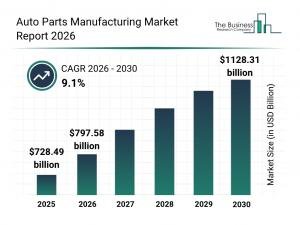
The auto parts manufacturing sector has experienced notable growth in recent years, fueled by evolving vehicle production methods and technological breakthroughs. As the automotive landscape transforms at a brisk pace, this market is poised for continued expansion, reflecting a rising appetite for cutting-edge and efficient components. Let’s examine the market’s scale, growth catalysts, major segments, emerging developments, geographic patterns, and the key players steering the future of auto parts manufacturing.
Also worth a look: Accessible Events Show USA launches first U.S. edition on UN disability day with practical inclusion focus and PetVivo brings its equine joint treatment to Las Vegas for AAEP convention.
Auto Parts Manufacturing Market Size and Expansion Projections
The auto parts manufacturing market has demonstrated robust recent growth and continues to offer promising momentum. It is projected to climb from $728.49 billion in 2025 to $797.58 billion in 2026, representing a compound annual growth rate (CAGR) of 9.5%. This upward trajectory over the recent period has been propelled by rising global vehicle output, expanded automotive production capacity, heightened demand for replacement components, adoption of sophisticated automotive technologies, and growth in aftermarket services. Looking further ahead, the market is anticipated to reach $1,128.31 billion by 2030, advancing at a CAGR of 9.1%. The drivers behind this future expansion include growing electric vehicle production, demand for lighter vehicle parts, an expanding vehicle parc and associated replacement needs, increasing component exports, and a greater need for advanced safety and electronic modules. Key trends influencing the market encompass wider use of lightweight materials, enhanced safety features, modular automotive parts, increased localization of manufacturing, and demand for high-performance components.
Download a free sample of the auto parts manufacturing market report:
https://www.thebusinessresearchcompany.com/sample_request?id=65564344&type=smp&name=Auto%20Parts%20Manufacturing%20Market%20Report%202026&utm_source=EINPresswire&utm_medium=Paid&utm_campaign=Nov_PR
Primary Drivers Behind Auto Parts Manufacturing Growth
A central engine driving the auto parts manufacturing industry is the consistent uptick in vehicle production worldwide, covering passenger cars, commercial vehicles, buses, and trucks. This production increase is largely tied to growing consumer appetite for personal mobility, fueled by urbanization, rising living standards, and greater disposable incomes. As more individuals buy vehicles for flexible transport, manufacturers scale up output accordingly. That, in turn, stimulates demand for original equipment manufacturer (OEM) components—including engine parts, electrical systems, braking mechanisms, and interior assemblies—needed for assembling new vehicles. For instance, in April 2026, the International Organization of Motor Vehicle Manufacturers (OICA) reported that global vehicle production rose from 92.7 million units in 2024 to 96.4 million units in 2025, a 3.9% increase. This steady climb in vehicle output directly underpins growth in the auto parts manufacturing market.
Additional Factors Fueling Market Expansion
Beyond vehicle production itself, the intensifying focus on electric vehicles and advanced technological components is further stoking demand for auto parts. Stricter regulatory requirements for safer, more efficient, and environmentally friendlier vehicles push manufacturers to develop components that meet these evolving standards. The expansion of automotive aftermarket services, combined with rising replacement demand across the global vehicle parc, also bolsters this market’s growth. Taken together, these forces create a fertile environment for sustained expansion in the auto parts manufacturing industry.
View the full auto parts manufacturing market report:
https://www.thebusinessresearchcompany.com/report/auto-parts-manufacturing-market-report?utm_source=EINPresswire&utm_medium=Paid&utm_campaign=Nov_PR
Breakdown of Leading Segments in the Auto Parts Manufacturing Market
The auto parts manufacturing market has been segmented in detail to pinpoint where growth is most pronounced. These segments include: 1) Component-wise divisions such as Engine Parts, Transmission Parts, Electrical Parts, Suspension and Steering Parts, Braking System Parts, Body Parts, Interior Components, and Other Components. 2) Different materials used like Metal, Plastic, Rubber, and Composites. 3) Vehicle types including Heavy Commercial Vehicles, Passenger Cars, Light Commercial Vehicles, and others. 4) Application areas split between Original Equipment Manufacturer (OEM) and Aftermarket. Further subcategories under Engine Parts include pistons, cylinder heads, engine blocks, crankshafts, valves, fuel injection systems, turbochargers, air intake, and exhaust components. Transmission Parts cover gears, clutches, shafts, torque converters, cases, differential components, control units, bearings, and bushings. Electrical Parts consist of batteries, alternators, starters, wiring harnesses, control units, sensors, lighting, and infotainment items. Suspension and Steering Parts feature shock absorbers, struts, springs, control arms, ball joints, steering columns, racks, tie rods, and stabilizers. Braking System Parts include brake pads, discs, drums, calipers, lines, master cylinders, and anti-lock braking components. The Body Parts category involves doors, hoods, fenders, bumpers, roof panels, grilles, frames, and exterior trims. Interior Components cover seats, dashboards, instrument panels, door panels, lighting, floor coverings, climate controls, and safety restraints. Other Components comprise wheels, tires, cooling systems, fasteners, thermal management parts, and electric vehicle components.
Innovations and Trends Shaping the Auto Parts Manufacturing Industry
Leading players in the auto parts manufacturing market are increasingly zeroing in on innovations that boost vehicle performance, safety, and production efficiency. A notable development is the creation of advanced automotive steel materials designed to contribute to vehicle lightweighting without sacrificing strength or durability. These engineered steels offer improved corrosion resistance and better formability compared to traditional steel, enabling manufacturers to produce lighter, stronger, and more fuel-efficient vehicle components. For example, in June 2026, ArcelorMittal Nippon Steel India Limited unveiled Zagnelis Protect Steel, a patented steel solution featuring a zinc-magnesium-aluminium coating that delivers superior corrosion protection. This advanced material enhances surface durability and extends component lifespan, outperforming standard galvanized steel. Zagnelis Protect Steel is particularly suited for electric, passenger, and commercial vehicles, supporting the creation of lightweight, durable, and reliable auto parts that meet modern performance and sustainability goals.
Regional Breakdown and Market Growth Hotspots
In 2025, Asia-Pacific stood as the largest region for the auto parts manufacturing market and is expected to retain its position as the fastest-growing region in the years ahead. The market analysis also covers other major regions such as South East Asia, Western Europe, Eastern Europe, North America, South America, the Middle East, and Africa, offering a broad perspective on where growth and investment are concentrated globally.
Top Players Driving Innovation and Competition in Auto Parts Manufacturing
Several key companies dominate the auto parts manufacturing landscape, setting trends and advancing technology. Notable players include Robert Bosch GmbH, Continental AG, Denso Corporation, ZF Friedrichshafen AG, Contemporary Amperex Technology Co. Ltd., Hyundai Mobis Co. Ltd., Magna International Inc., Aisin Corporation, Forvia SE, Sumitomo Electric Industries Ltd., Valeo SE, Lear Corporation, Hitachi Astemo Ltd., Tenneco Inc., Weichai Power Co. Ltd., Aptiv PLC, BorgWarner Inc., Mahle GmbH, OPmobility SE, Toyota Boshoku Corporation, Marelli Holdings Co. Ltd., Schaeffler AG, JTEKT Corporation, Dana Incorporated, NSK Ltd., American Axle & Manufacturing Holdings Inc., and Brembo S.p.A. These companies are instrumental in pushing the boundaries of material science, safety systems, and manufacturing processes within the auto parts sector.
New additions to our 2026 reports:
• Market attractiveness scoring and analysis
• Total addressable market (TAM) analysis
• Company scoring matrix graphics and tables
• Excel-based forecasting dashboards
• Market hotspots infographics
• Key technologies and future trend analysis
• Updated graphics and tables
Speak With Our Expert:
Saumya Sahay
Americas +1 310-496-7795
Asia +44 7882 955267 & +91 8897263534
Europe +44 7882 955267
Email: marketing@tbrc.info
The Business Research Company – www.thebusinessresearchcompany.com
Follow Us On:
• LinkedIn: https://in.linkedin.com/company/the-business-research-company
Oliver Guirdham
The Business Research Company
+44 7882 955267
info@tbrc.info
Visit us on social media:
LinkedIn
Facebook
X
Why it matters: The projected $1.13 trillion market size underscores how deeply auto parts manufacturing is intertwined with global economic trends, from urbanization to the EV transition. For suppliers, investors, and policymakers, this data signals where to focus resources—particularly in Asia-Pacific—as vehicle electrification and lightweight materials reshape the industry’s foundation.