
Pet owners are spending more than ever on their animals’ health, and the numbers prove it. A new report from The Business Research Company reveals that the companion animal diagnostics market is not just growing—it is accelerating at a pace that signals a fundamental shift in how people care for their pets.
The Business Research Company’s Companion Animal Diagnostics Global Market Report 2026 – Market Size, Trends, And Forecast 2026-2035
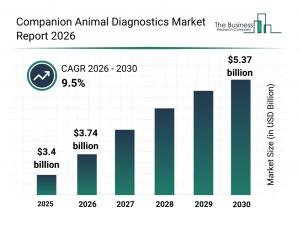
The companion animal diagnostics sector has experienced notable expansion in recent years, driven largely by a heightened focus on pet health and wellness. As more households welcome pets and invest substantially in their well-being, the appetite for advanced diagnostic tools and services continues to climb. This overview examines the market’s current valuation, growth trajectory, primary drivers, regional dynamics, and the emerging trends that will define its future.
Also worth a look: The Radiology Group takes on Florida’s rural imaging crisis with new WeCARE platform and Nkuringo Eco Collection adds Marafiki Safari Lodge, linking Uganda’s top wildlife regions in one trip.
The companion animal diagnostics market has grown rapidly in recent years. According to the report, it is projected to climb from $3.4 billion in 2025 to $3.74 billion in 2026, reflecting a compound annual growth rate (CAGR) of 9.8%. That surge is tied to several converging factors: a rising number of pet owners, greater spending on veterinary care, expansion of diagnostic laboratories, increased awareness of preventive medicine, and the availability of state-of-the-art testing technologies.
Download a free sample of the companion animal diagnostics market report:
https://thebusinessresearchcompany.com/sample_request?id=86491968&type=smp&name=Companion%20Animal%20Diagnostics%20Market%20Report%202026&utm_source=EINPresswire&utm_medium=Paid&utm_campaign=Nov_PR
Looking further ahead, the market is expected to sustain its momentum, reaching $5.37 billion by 2030 with a CAGR of 9.5%. Analysts attribute this forecasted expansion to growing demand for personalized veterinary treatments, wider adoption of advanced molecular diagnostics, the emergence of home-based pet testing kits, significant investments in veterinary healthcare infrastructure, and a stronger emphasis on early disease detection in pets. Key trends during this period include the proliferation of point-of-care testing, expanded use of molecular diagnostics, integration of digital diagnostic platforms, growth in preventive health screening for pets, and a drive toward rapid, accurate diagnostic results.
Understanding the Scope of Companion Animal Diagnostics
Companion animal diagnostics encompass a broad range of testing and diagnostic methods designed to identify and manage health issues in pets such as dogs and cats. These services include blood tests, imaging techniques, and specialized assays that facilitate early illness detection and precise health monitoring. By making these diagnostics available, veterinarians can craft tailored treatment plans that improve health outcomes and elevate the overall quality of care for pets.
View the full companion animal diagnostics market report:
https://thebusinessresearchcompany.com/report/companion-animal-diagnostics-global-market-report?utm_source=EINPresswire&utm_medium=Paid&utm_campaign=Nov_PR
Rising Number of Pet Owners as a Key Growth Catalyst
Perhaps the most powerful engine behind this market growth is the swelling population of pet owners worldwide. Pet ownership has skyrocketed as more people recognize the emotional and health benefits of having animals and gain access to a wider array of pet-related products and services. Companion animal diagnostics are critical here: they deliver essential health insights and enable early disease detection, helping owners provide timely and effective medical attention.
Consider this data point: In March 2025, the American Pet Products Association (APPA), a prominent nonprofit trade group in the U.S. pet industry, reported that approximately 94 million U.S. households owned at least one pet in 2024—up from 82 million in 2023. Notably, around 18.8 million (20%) of these pet-owning households were led by Generation Z, marking a 43.5% increase in Gen Z’s share compared to the prior year. This demographic shift underscores how a growing and younger base of pet owners is directly boosting the companion animal diagnostics market.
Regional Leaders in the Companion Animal Diagnostics Market
In 2025, North America captured the largest share of the companion animal diagnostics market, buoyed by advanced veterinary infrastructure and high pet ownership rates. Meanwhile, the Asia-Pacific region is expected to see the fastest growth throughout the forecast period, driven by rising pet adoption, expanding veterinary services, and increasing awareness of pet health.
The comprehensive market report covers key geographic zones, including Asia-Pacific, South East Asia, Western Europe, Eastern Europe, North America, South America, the Middle East, and Africa, offering a global perspective on market trends and opportunities.
Our 2026 reports feature deeper market intelligence with market attractiveness scoring and analysis, total addressable market (TAM) analysis, company scoring matrix graphics and tables, Excel-based forecasting dashboards, market hotspots infographics, key technologies and future trend analysis, and updated graphics and tables.
Speak With Our Expert:
Saumya Sahay
Americas +1 310-496-7795
Asia +44 7882 955267 & +91 8897263534
Europe +44 7882 955267
Email: marketing@tbrc.info
The Business Research Company – www.thebusinessresearchcompany.com
Follow Us On:
• LinkedIn: https://in.linkedin.com/company/the-business-research-company
Oliver Guirdham
The Business Research Company
+44 7882 955267
info@tbrc.info
Visit us on social media:
LinkedIn
Facebook
X
Why it matters: As pet ownership climbs—especially among Gen Z—the demand for advanced diagnostics is reshaping veterinary medicine into a more preventive, personalized field. For investors and pet owners alike, this market signals that animal healthcare is becoming a major, lasting economic force rather than a niche afterthought.