In a crowded field of recovery literature, a new book promises to shift the conversation from willpower to awareness. Author R. W. Dixon’s upcoming release, “Reflection,” positions recovery not as a battle against oneself, but as a disciplined practice of understanding where one’s attention is anchored.
Reflection Recovery
Reflection Out November 11th
Also worth a look: Chef Jeffrey James Trench takes the reins of The Chef Tours’ Seville wine and tapas experience and HandicapMD breaks down Washington’s TD-420-073 placard rules and medical certification.
Reflection by R. W. Dixon, out Nov. 11: recovery as an architecture of attention — Knowledge, Acceptance, Humility — and the space between trigger and reaction.
At the heart of Dixon’s philosophy is a bold assertion: “Knowledge is the quintessential component to recovery. However, without Acceptance and Humility, Knowledge would cease to exist.”— R. W. Dixon
CENTREVILLE, VA, UNITED STATES, October 27, 2026 /EINPresswire.com/ — AUTHOR R. W. DIXON ANNOUNCES “REFLECTION”: A TRANSFORMATIVE APPROACH TO RECOVERY USING SPATIAL DISAMBIGUATION
His new book, slated for release on November 11, presents Recovery as an Architecture of Attention — a framework built on the premise that where you stand determines what you see.
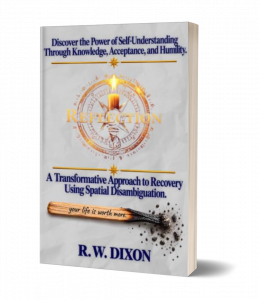
R. W. Dixon, the author and founder of Reflection Recovery, has officially announced the November 11, 2026 publication of his new work, Reflection: A Transformative Approach to Recovery Using Spatial Disambiguation.
The book offers a pragmatic system for those grappling with substance use disorder, focusing on mastering the architecture of one’s attention rather than merely resisting urges. The methodology, grounded in philosophical thought and personal experience, rests entirely on three foundational principles:
- Knowledge: Cataloging the objective, unvarnished truth of one’s personal history.
- Acceptance: Building an expanded, stable capacity to hold that history without running, flinching, or falling into cycles of self-loathing.
- Humility: Cultivating the willingness to let what has been cataloged and accepted reshape who one is becoming, rather than constantly defending who one used to be.
Central to the book’s approach is the concept of spatial disambiguation—a practical method for mapping context, events, and time/place to resolve ambiguity in both primary and secondary observations. This technique teaches individuals to consciously note where their attention is positioned relative to their experiences, highlighting the crucial gap between an external trigger and an internal reaction. By recognizing that space, they can position themselves to make long-term recovery achievable.
“Nobody handed me the book I needed,” says author R. W. Dixon. “So I wrote the method I wished someone had given me: not a brutal, constant fight with your own brain, but a way to stand somewhere steadier and see clearly from there.”
The launch is accompanied by live digital tools hosted by the Reflection Recovery community, including a public, interactive days-sober signature wall at reflectionrecovery.org/magicwall. This platform allows community members to log their consecutive days of sobriety in a shared, transparent space, standing alongside others on the same path.
A free introductory digital package, containing the complete book Prologue and Introduction, is available immediately at reflectionrecovery.org/freebie. Reflection: A Transformative Approach to Recovery Using Spatial Disambiguation is available for pre-order now on Amazon and officially publishes on November 11, 2026, in both paperback and ebook formats.
Why it matters: Dixon’s framework shifts the focus from fighting addiction to understanding the spatial dynamics of perception, offering a potentially sustainable path for those who have found traditional methods lacking. By emphasizing a structured method of attention, this book could provide a new entry point for individuals seeking a different kind of recovery strategy.
R. W. Dixon
Reflection Recovery
Dixon@ReflectionRecovery.org
Visit us on social media:
LinkedIn
Instagram
Facebook
YouTube
TikTok
X
Other